
For parents · Classes 7 to 10 · ICSE / CBSE / SSLC
You do not need to know chemistry. The book marks itself.
Your child marks their own work against answers printed in the book. You set the exercise and check the score. Below the gate, the chapter is repeated. That is the whole of your job.
The Playbook carries its own charts, its own answers and its own evaluation chart, so the adult in the room never has to teach the subject. It does not require you to remember a valency.
Play the round below before you read any further — it is one formula, built the way Chapter II builds every one of them, and it takes about thirty seconds.
Token Play
Join a token to a token. Watch the formula appear.
One round, the way a student plays it on a table with the punch-out sheet from The Language of Chemistry.
Choose a token, then choose the slot it belongs in. One element, one radical, and the valency that joins them — only one of the three numbered tokens is right. The valency is how many the element combines as; it is not part of the finished formula. On a keyboard: tab to a token, press Enter to pick it up, then tab or arrow to a slot and press Enter to drop it. Escape puts it back.
On the bench
The join
Choose a token to begin.
NaCl
The valencies crossed over. Sodium combines as one and chloride combines as one, so one of each is all it takes — and a subscript of 1 is never written. This is the book's first worked example, on page 28.
That is one word in the language of chemistry. The book has 19 exercises and 279 questions like it, and the tokens come punched out on 2 sheets inside it.
It is rarely the chemistry. It is the writing.
The reactions make sense in class and the marks still go missing, because the answer has to be written in a notation nobody set aside a week to teach — a symbol, then a valency, then a formula, then a balanced equation. Every board sets that notation. None of them stops to build it.
Chemistry involves the study of a large number of Elements and Compounds. It is very inconvenient to write the Full Names of Elements and Compounds. The creation of Symbols and Formula solved this problem. […] The 10th standard CBSE, ICSE and SSLC Examinations reveals the fact that the students find it very difficult to write Symbols, Chemical Formula and Balanced Chemical Equations.
That is why the help a parent instinctively offers — explaining the reaction again — does not land. The gap is upstream of it.
What a parent does, in five steps.
The book repeats one loop for all 3 chapters — chart, activity, exercise, score, gate. Each step below is what you do, and what you deliberately do not.
Step 1 · Chart
Open the chart and leave it open. Chapter I is thirty elements and twenty-five radicals, and the tokens punch out of two sheets at the back — do that with them, once, before anything else.
You do not have to know any of it. The chart is the reference; your child reads it, not you.
Step 2 · Activity
Let them build. There are 6 Activities in Chapter I and they are all done with the tokens in hand — names and symbols first, then valencies, then the radicals sorted into simple and compound.
You do not correct a token that is in the wrong place. The next Activity is what corrects it.
Step 3 · Exercise
Set one Exercise and go away. There are 19 across the three chapters and 279 questions in them.
You do not sit beside them with the answers. Every answer is enclosed in the book, and it is enclosed so the student can check afterwards — not so an adult can prompt during.
Step 4 · Score
Mark it together against the enclosed answers and write the figure on the evaluation chart on p111.
You do not round it up. The chart is the only record of where they actually are.
Step 5 · Gate
Compare the score to the gate. Chapter I closes at 172 of 184. At or above it, the next chapter opens.
Below it, the whole set of Exercises is repeated before the next chapter opens. That is the book working, and it is the part to hold your nerve on.
Nothing in this loop asks you to know the answer. It asks you to keep the answers closed until the Exercise is finished, which is the one thing that decides whether the score means anything.
The gate
The book sends a student back. On purpose.
Each chapter ends in a score read against a chart at the back. Below the threshold the whole set of exercises is repeated before the next chapter opens. Chapter I closes at 93.5%, which is a standard, not a pass mark.
Chapter I · Alphabets
172 / 184
93.5% to proceed
Chapter II · Words
37 / 40
92.5% to proceed
Chapter III · Sentences
51 / 55
92.7% to proceed
What happens at 171 out of 184.
The set is repeated. Not a remedial worksheet, not a different chapter — the same 12 Exercises again, until 172 of 184 are right. Chapter I closes at 93.5%, which is a standard, not a pass mark.
This is the part parents ask about most, and it is the part worth not overriding. Chapter II asks a student to write chemical formulas; a student who is still guessing at valencies cannot write one, and pushing them forward buys a fortnight and loses the chapter. The repeat is the book doing what you bought it for.
It will not make the subject easy, and it is not meant to. It makes the notation automatic, which is the thing the exam actually tests under time.
What is in the box
A Playbook is not a book. It contains a game.
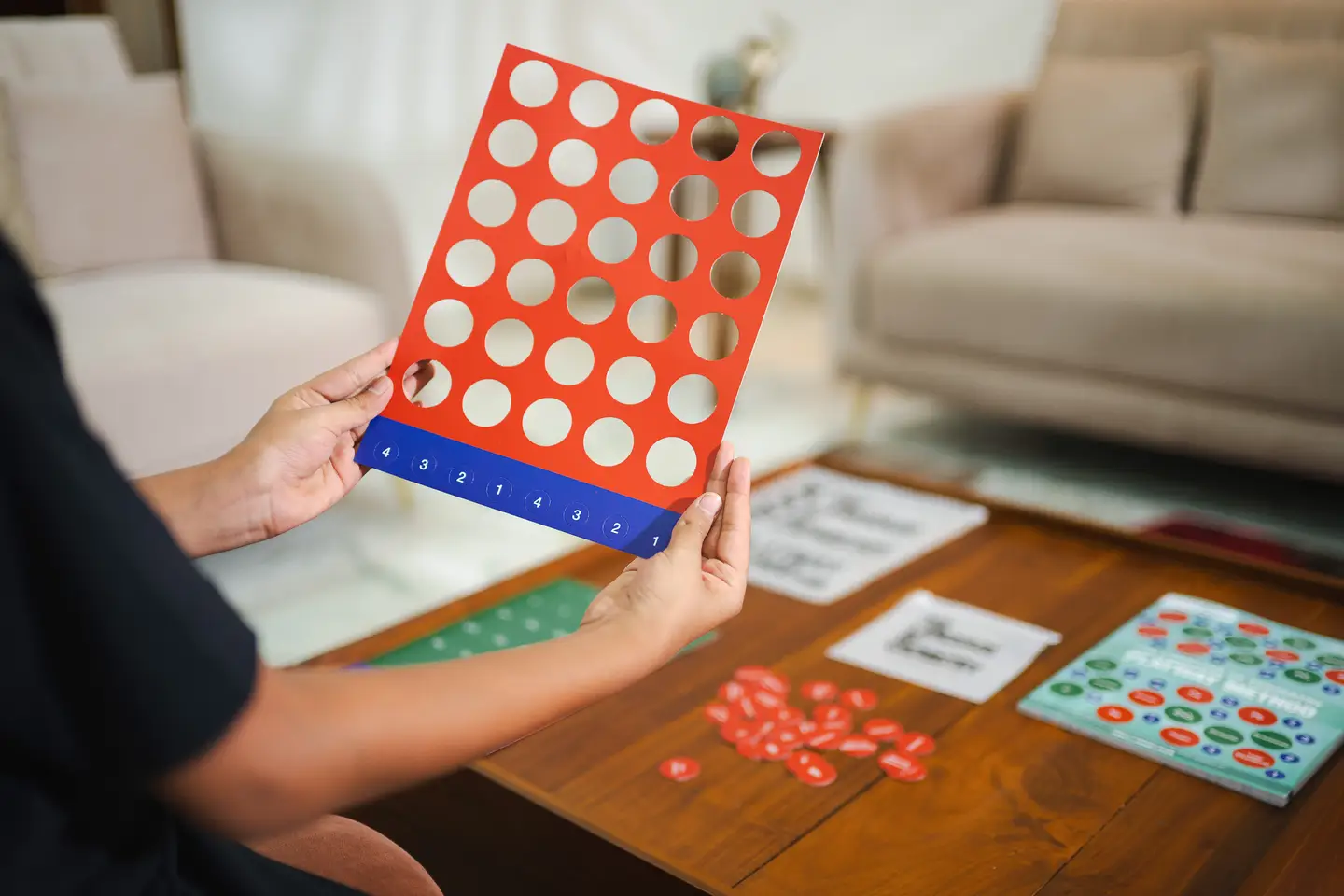
2 punch-out token sheets
Thirty elements, twenty-five radicals and the valencies that join them, printed and die-cut so a student pushes them out and puts them on a table. The word on each token is the code, and the colour repeats it — an element, a radical, a valency. A radical carries an inner ring as well, so the three types stay apart on a photocopy and for a reader who cannot separate the red from the green.
- Na
- 1
- Cl
The three types are told apart by what they carry and how they are drawn, not by colour — a radical carries a ring, a valency is smaller and set in figures.
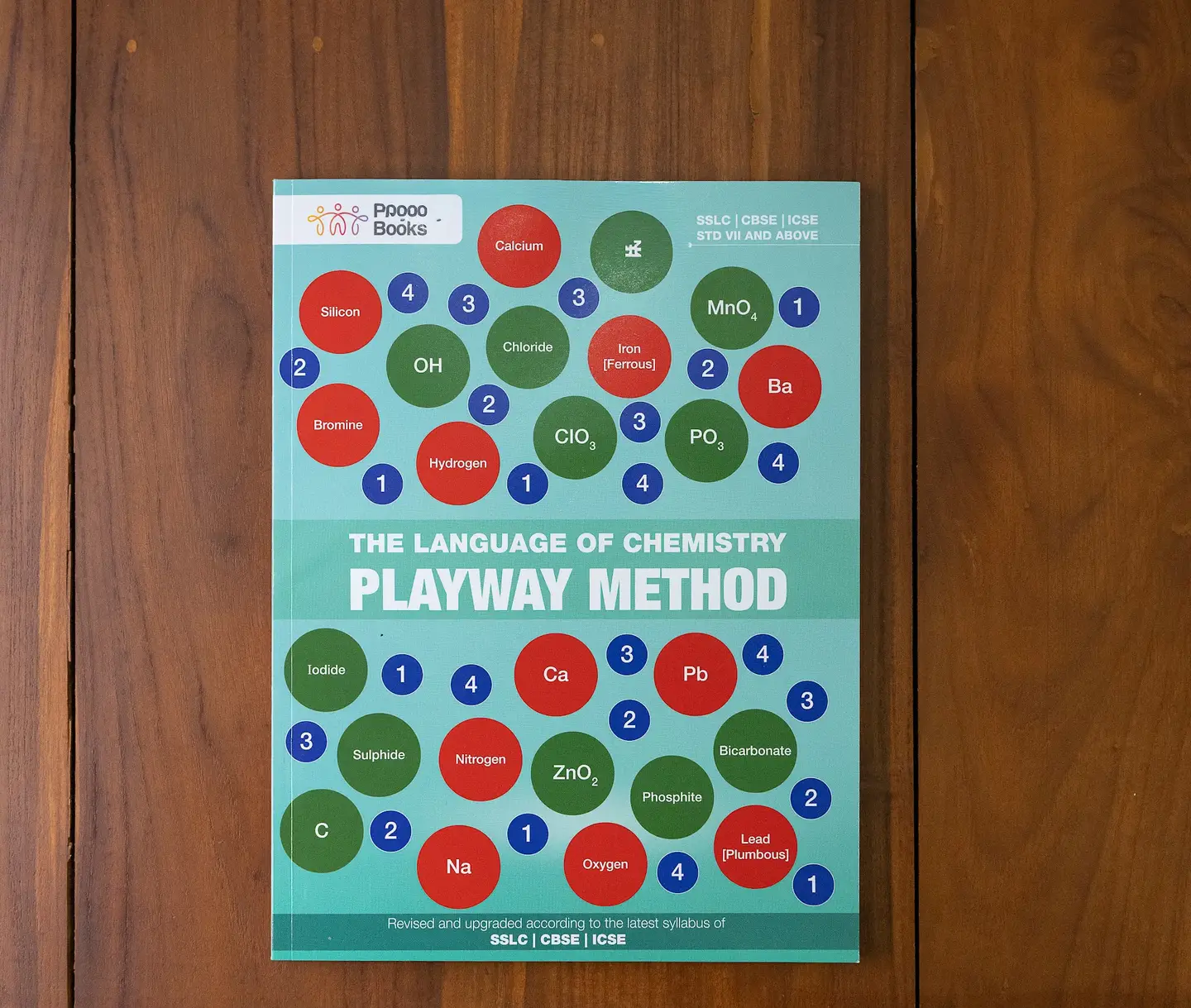
112 pages
The method, the charts, the activities and the exercises — in the order a student works through them.
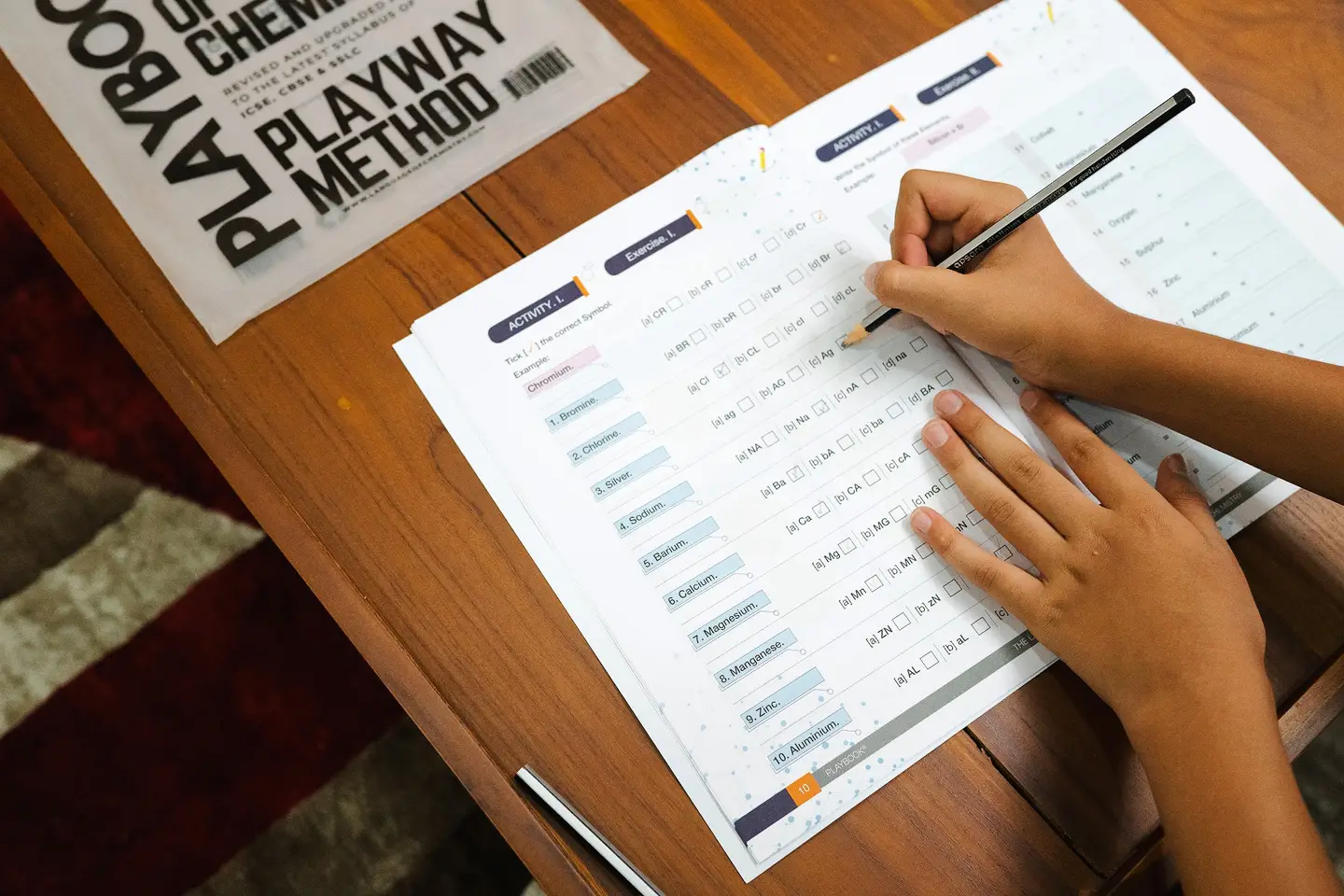
19 exercises, 279 questions
Across 6 activities and 2 charts. Enough repetition for the notation to become automatic, which is the entire point of drilling a language.
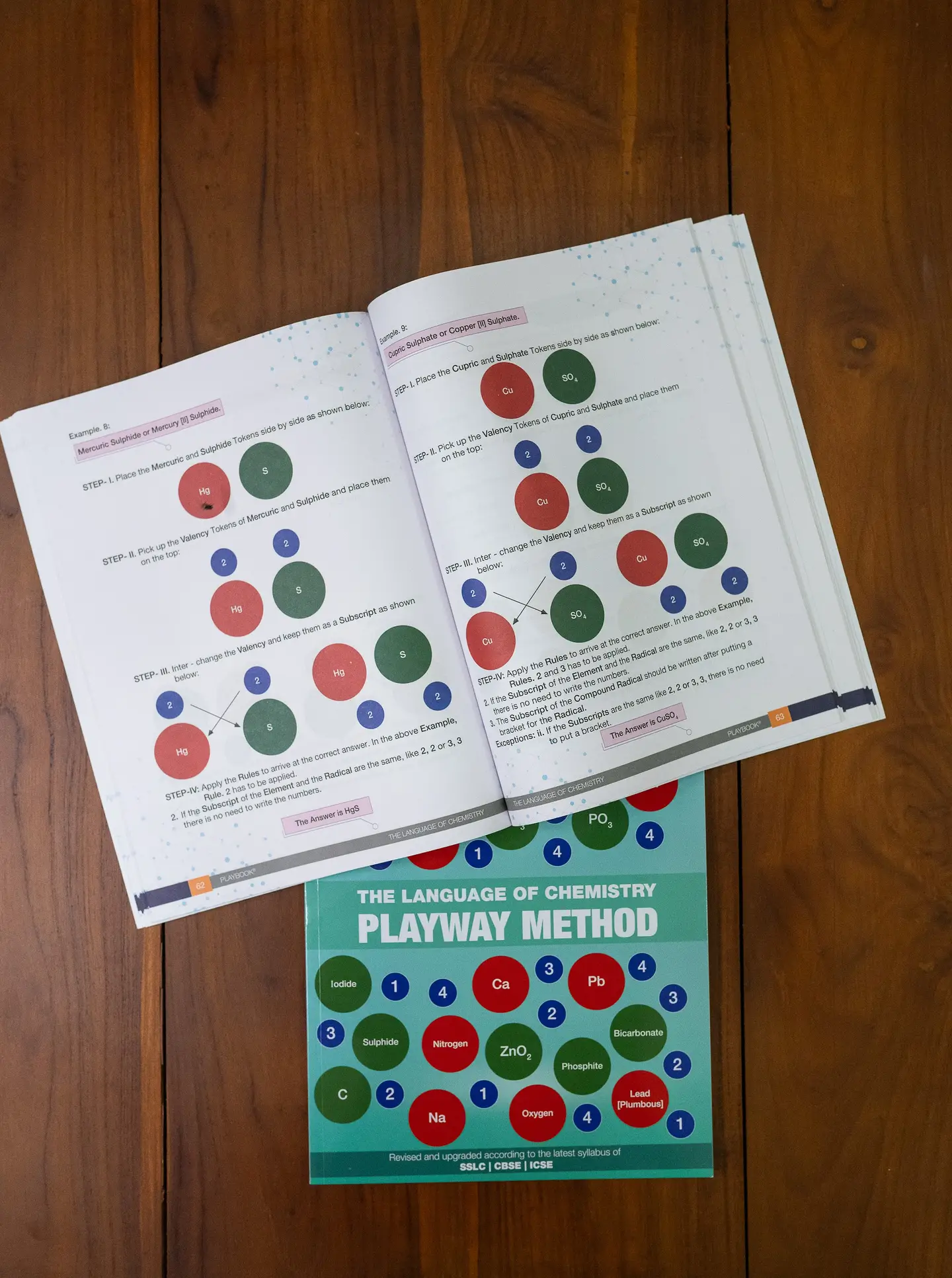
All answers enclosed
The book marks itself. A parent who never studied chemistry can still check the work, and nothing is held back for a separate guide.
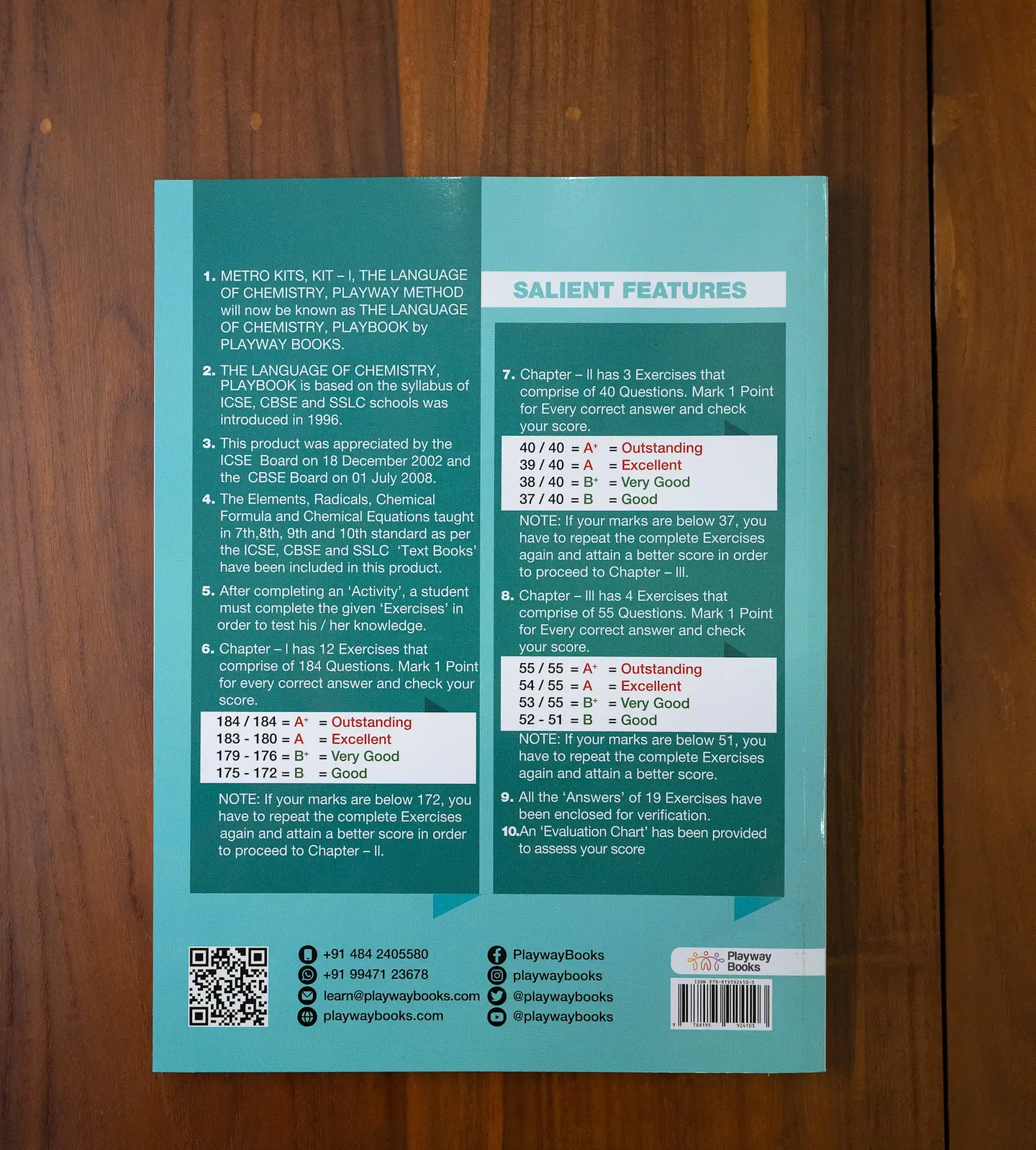
Evaluation chart
Scores are read against a chart, because the chapter gate is a number and not an opinion.
Before you buy anything.
Three pages of this site give away enough of the method to judge it. Practice sets are free and ungated — formulas to write and equations to balance, for your child's board, with the answers held back on a separate block. Valency and radicals is the chart Chapter I teaches. Look inside is the book itself.
And For students is this same page written to your child rather than to you — the five steps from their side of the table, and the round to play before they start. It is worth reading together.
Questions
What parents ask before they buy
I do not know any chemistry. Can I still use this with my child?
Yes, and the book is built on the assumption that you cannot. Every chart, every worked example and every answer is inside it. What an adult provides is the timetable and the marking, and the marking is against answers that are printed.
How long does a chapter take?
That is set by the score rather than by a calendar. Chapter I is 12 Exercises and 184 questions, and it does not close until 172 of 184 are right — 93.5%. A student who gets there in a fortnight moves on in a fortnight; a student who does not repeats the set.
My child scored below the gate and is upset. Do we push on anyway?
No. The whole method rests on not doing that — Chapter II asks a student to write chemical formulas, and a student who cannot yet recall a valency cannot write one. Repeating Chapter I is not a punishment, it is the only thing that makes Chapter II possible.
Is this a guide book or a substitute for the school textbook?
Neither. It teaches the notation — symbols, valency, formulas, equations — that every board sets and none of them sets aside time to teach. Your child still needs the textbook.
Do I need to buy anything else with it?
No. The two token sheets are inside the book, all 19 Exercises carry their answers, and the evaluation chart is on p111. There is nothing to download, print, subscribe to or log into.
Every question, including what is in the box and what it costs
Ready when you are.
There is no cart on this site. The Playbook ships from Amazon.in, Flipkart and JioMart, and it is on the shelf in Kerala — every store, with its own page, is one click away.