
Reference · 15 terms · ICSE / CBSE / SSLC
The words, in the order you meet them.
The words chemistry uses and does not stop to explain. Element, symbol, formula, valency, equation. Each one has a real example beside it, and they are in the order you meet them.
Chemistry is a branch of science and it has a written language: symbols, formulas and equations. Every board sets that language before any of them stops to teach it. These are the 15 terms you need to read it — element and symbol first, formula and valency next, equation and coefficient last.
They are not in alphabetical order, deliberately. An alphabetical glossary puts valency two places before symbol, which is the order that makes the notation look like a set of arbitrary conventions instead of a system with rules. 4 of the 15 are the Playbook's own definitions from page 6 and are marked as such; the rest are written here.
Before the three steps
What chemistry is, and what its language is
The subject, and the notation it is written in. The book teaches the second; the first is what the second is the language of.
- Chemistry
The branch of science that studies what materials are made of, how they are structured, what properties they have, and how they react to form new materials.
Sodium metal and chlorine gas joining to make table salt is chemistry: 2Na + Cl2 → 2NaCl. Writing that line down is the language of chemistry.
Defined here, not in the book
- The language of chemistry
The written notation the subject is recorded in: symbols for elements, formulas for substances, and equations for reactions. It is a part of chemistry, not another name for it.
Sodium is Na, sodium chloride is NaCl, and making it is 2Na + Cl2 → 2NaCl. A symbol, a formula and an equation — the whole of the language, in one reaction.
Defined here, not in the book
Step I · Chapter I
Alphabets
Full name, symbol, formula and the valency of 30 elements and 25 radicals.
- Element
A substance which is constituted of only one kind of matter.
Aluminium, Copper.
Defined in the Playbook, page 6
- Symbol
A short, scientific mode of representing atoms of elements.
Barium = Ba. Calcium = Ca.
Defined in the Playbook, page 6
- Valency
The combining capacity of an element, measured by the number of atoms of hydrogen with which one atom of an element can combine.
Sodium combines with one atom of hydrogen, so its valency is 1. Calcium combines with two, so its valency is 2.
Defined in the Playbook, page 6
- Radical
An atom or a group of atoms that carries a charge and enters a chemical formula as a single unit, keeping its own valency.
Chloride Cl is a simple radical — one element. Sulphate SO4 is a compound radical — a group that combines as one thing and is never split up.
Defined here, not in the book
- Subscript
The small figure written below and after a symbol, giving how many atoms of it are in one molecule. It is part of the formula and changing it changes the substance.
The 2 in H2O says two hydrogen atoms. H2O2 is a different substance, not more water.
Defined here, not in the book
Step II · Chapter II
Words
Chemical formula.
- Formula
A short, scientific mode of representing molecules of elements and compounds.
Hydrogen = H2 and oxygen = O2 are elements; water = H2O and sodium chloride = NaCl are compounds.
Defined in the Playbook, page 6
- Criss-cross rule
The method for writing a formula from two valencies: each part takes the other part’s valency as its subscript, and the pair is reduced to its lowest terms.
Calcium is divalent, hydroxide is monovalent, so calcium hydroxide is Ca(OH)2. Magnesium and oxide are both divalent, so the pair reduces and magnesium oxide is MgO.
Defined here, not in the book
- Compound
A substance made of two or more different elements chemically joined in a fixed ratio.
Water H2O and sodium chloride NaCl are compounds; hydrogen H2 and oxygen O2 are not.
Defined here, not in the book
- Variable valency
A metal that combines in more than one ratio, and therefore has more than one valency. Its name has to say which, or no formula can be written from it.
Iron is divalent as ferrous and trivalent as ferric: FeO is Iron(II) Oxide and Fe2O3 is Iron(III) Oxide. “Iron Oxide” on its own is not an answerable question.
Defined here, not in the book
Step III · Chapter III
Sentences
Chemical equations.
- Chemical equation
A reaction written in formulas: what goes in on the left, what comes out on the right, joined by an arrow.
Calcium oxide and water give calcium hydroxide: CaO + H2O → Ca(OH)2.
Defined here, not in the book
- Reactant and product
The reactants are the substances written to the left of the arrow; the products are what is written to its right.
In CaCO3 → CaO + CO2, the carbonate is the reactant and the two on the right are products.
Defined here, not in the book
- Coefficient
The whole number written in front of a formula, multiplying every atom in it. Coefficients are what may be changed when balancing; subscripts are not.
In 3BaCl2 the coefficient is 3, which is 3 barium atoms and 6 chlorine atoms. A coefficient of 1 is never written.
Defined here, not in the book
- Balanced equation
An equation in which every element has the same number of atoms on both sides of the arrow, reached by changing coefficients only.
Iron(III) oxide and aluminium balance at two and two: Fe2O3 + 2Al → Al2O3 + 2Fe.
Defined here, not in the book
Which of these are the book's words.
4: element, symbol, formula and valency. They are printed on page 6 of The Language of Chemistry, Playbook® and are quoted here exactly as Lilly Joseph wrote them, because a definition tidied up in transit is no longer a quotation.
The remaining 11 are Playway Books writing plainly for this page. They are not the book's definitions and are not presented as them — a distinction that matters more than it looks, because a glossary is exactly the kind of page whose sentences get quoted back without their source.
Questions
- What is valency?
- The combining capacity of an element, measured by the number of atoms of hydrogen with which one atom of an element can combine.
- What is the difference between a formula and an equation?
- A formula names one substance — H2O is water. An equation describes a reaction between substances, written in formulas, with what goes in on the left and what comes out on the right. A formula is a word; an equation is a sentence.
- What is the difference between a subscript and a coefficient?
- A subscript is the small figure inside a formula and belongs to the substance — the 2 in H2O. A coefficient is the full-size figure in front of a formula and says how many of that substance there are — the 3 in 3BaCl2. When balancing an equation you may change a coefficient and never a subscript.
- What is a radical in chemistry?
- An atom or group of atoms carrying a charge that enters a formula as a single unit with its own valency. A simple radical is one element — chloride, oxide. A compound radical is a group that combines as one thing — sulphate, nitrate, ammonium, hydroxide.
A definition is where it starts, not where it ends.
Knowing what valency means is not the same as knowing that calcium's is 2, and knowing that is not the same as being able to write Ca(OH)2 under exam conditions without stopping to think. That last step is the one the Playbook is for, and it is the reason its chapters are gated on a score rather than finished by reading them.
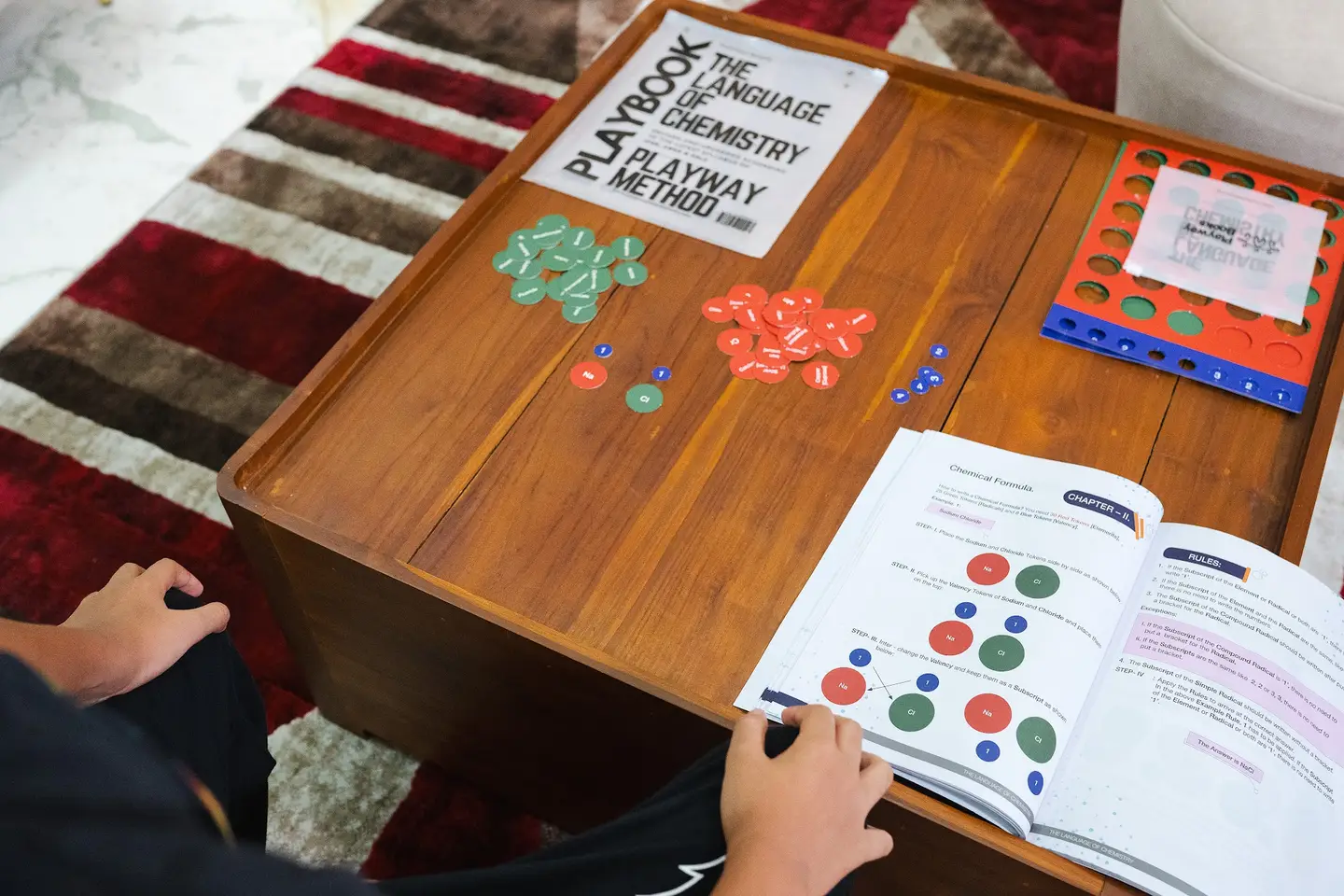
- The valency chart — every element and radical the boards set.
- The formula index — what those parts build, with the derivation.
- Balancing equations — two worked step by step.
- Practice sets — free, by board, with the answers held back.