
Reference · ICSE / CBSE / SSLC · Classes 7 to 10
Valency, and the radicals worth learning first.
This is a valency chart. Find an element or a radical, and the number beside it is how many bonds it makes. You need that number before you can write a single formula. This is Step I of three.
Both of the book’s charts are here in full — thirty elements and twenty-five radicals — with the rule that turns two valencies into a formula. Nothing here is a trick. It is the alphabet the rest of chemistry is written in, and it is the first thing The Language of Chemistry, Playbook® teaches.
Thirty is a count of rows, and of tokens. Chart I runs to 30 rows but 26 elements: copper, mercury, iron and lead each appear twice, once for each valency they combine at, and Activity I punches out thirty red tokens to match the rows. The same chapter gives twenty-five radicals twenty-five green tokens, with no repeats.
These valencies are checked rather than asserted. Applied through the criss-cross rule they rebuild 86 of the 94 chemical formulas the ICSE, CBSE and Kerala SSLC syllabuses set — every run of this site’s build tests it. The 8 they do not rebuild are named at the bottom of the page, with the reason.
By name, symbol, formula or valency — sodium, Na, SO4, 2. Every row stays on the page; this only narrows what is shown.
The elements, and what each combines as.
Chart I as the book prints it, grouped by valency and numbered one to thirty. Every row says whether the three boards set it: 23 of these elements appear in a formula an ICSE, CBSE or Kerala SSLC textbook actually asks for, and the rest are in the book against the day a student meets them. A metal with two valencies gets a row for each, with the classical name for that state, because those names are what the boards print and do not explain.
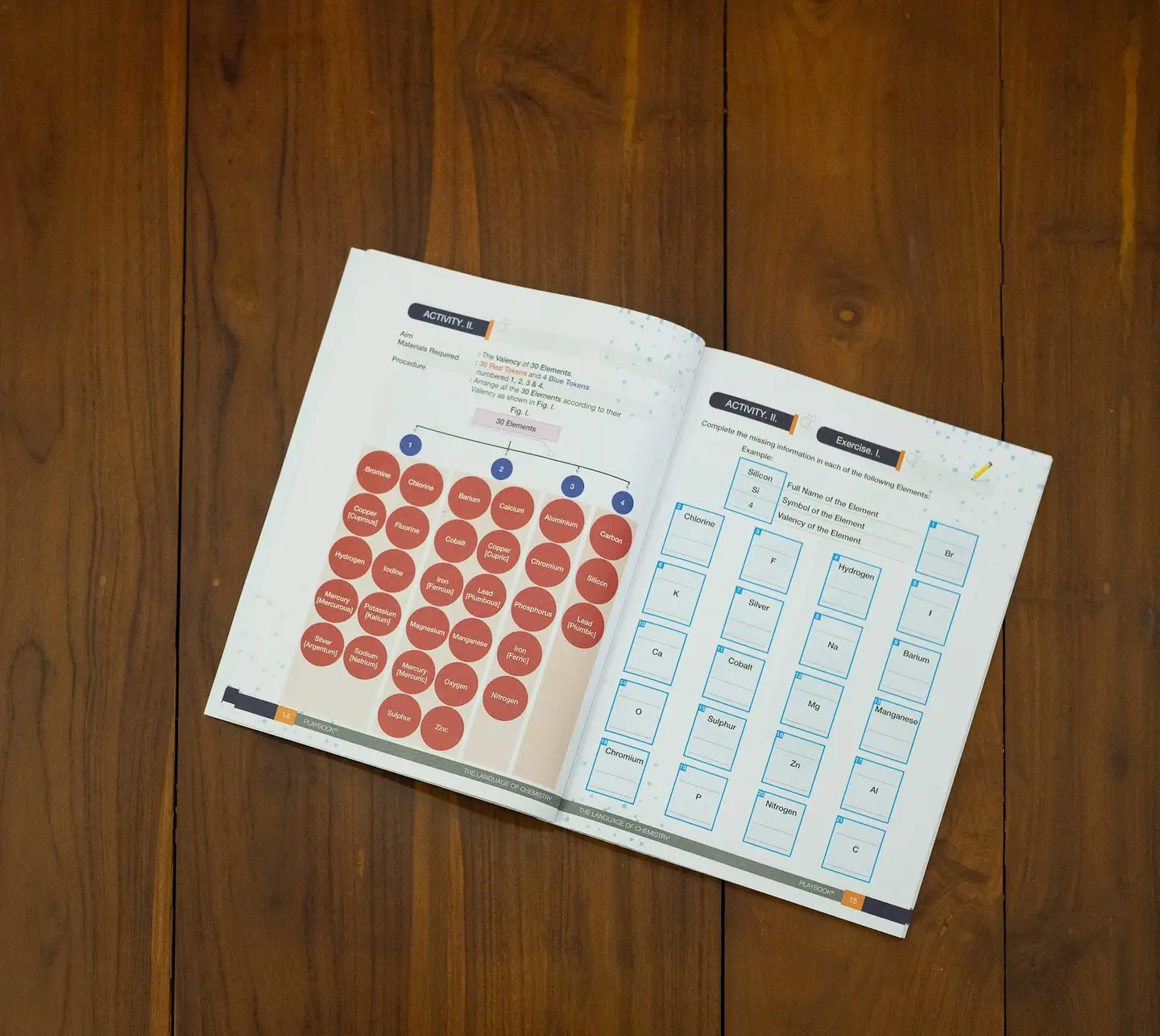
Two valencies here are the boards’ rather than the book’s, and they are marked as such. Manganese at 4 is the one that earns its place by arithmetic — it is what builds MnO2, and without it the rule below would rebuild 85 of the boards’ formulas rather than 86. Phosphorus at 5 builds nothing at all; it is here because the boards’ own naming assumes it, and it sits outside the four valency names the book gives.
| No. | Symbol | Element | Valency | Where it comes from | Note |
|---|---|---|---|---|---|
| Monovalent | |||||
| 1 | Br | Bromine | 1 | Chart I · set by the boards | — |
| 2 | Cl | Chlorine | 1 | Chart I · set by the boards | — |
| 3 | Cu | Copper [Cuprous] | 1 | Chart I · set by the boards | — |
| 4 | F | Fluorine | 1 | Chart I · set by the boards | — |
| 5 | H | Hydrogen | 1 | Chart I · set by the boards | — |
| 6 | I | Iodine | 1 | Chart I · set by the boards | — |
| 7 | Hg | Mercury [Mercurous] | 1 | Chart I · set by the boards | — |
| 8 | K | Potassium [Kalium] | 1 | Chart I · set by the boards | — |
| 9 | Ag | Silver [Argentum] | 1 | Chart I · set by the boards | — |
| 10 | Na | Sodium [Natrium] | 1 | Chart I · set by the boards | — |
| Divalent | |||||
| 11 | Ba | Barium | 2 | Chart I · set by the boards | — |
| 12 | Ca | Calcium | 2 | Chart I · set by the boards | — |
| 13 | Co | Cobalt | 2 | Chart I · no board formula uses it | — |
| 14 | Cu | Copper [Cupric] | 2 | Chart I · set by the boards | — |
| 15 | Fe | Iron [Ferrous] | 2 | Chart I · set by the boards | — |
| 16 | Pb | Lead [Plumbous] | 2 | Chart I · set by the boards | — |
| 17 | Mg | Magnesium | 2 | Chart I · set by the boards | — |
| 18 | Mn | Manganese | 2 | Chart I · set by the boards | Divalent in MnCl2, tetravalent in MnO2. In KMnO4 it is inside the permanganate radical. |
| 19 | Hg | Mercury [Mercuric] | 2 | Chart I · set by the boards | — |
| 20 | O | Oxygen | 2 | Chart I · set by the boards | — |
| 21 | S | Sulphur | 2 | Chart I · set by the boards | Divalent as the sulphide. Sulphur shows 4 in SO2 and 6 in SO3; those are covalent oxides and are not built by the criss-cross rule. |
| 22 | Zn | Zinc | 2 | Chart I · set by the boards | — |
| Trivalent | |||||
| 23 | Al | Aluminium | 3 | Chart I · set by the boards | — |
| 24 | Cr | Chromium | 3 | Chart I · no board formula uses it | — |
| 25 | P | Phosphorus | 3 | Chart I · set by the boards | Appears in the boards’ formulas only inside the phosphate and phosphite radicals. The book names four valencies and stops there, so the 5 has no token and no name in the chart. |
| 26 | Fe | Iron [Ferric] | 3 | Chart I · set by the boards | — |
| 27 | N | Nitrogen | 3 | Chart I · set by the boards | Trivalent in ammonia. In the boards’ formulas nitrogen otherwise appears inside a radical — nitrate or nitrite — rather than on its own. |
| Tetravalent | |||||
| 28 | C | Carbon | 4 | Chart I · set by the boards | — |
| 29 | Si | Silicon | 4 | Chart I · no board formula uses it | — |
| 30 | Pb | Lead [Plumbic] | 4 | Chart I · set by the boards | — |
| — | Mn | Manganese | 4 | Set by the boards · outside the book’s list | Divalent in MnCl2, tetravalent in MnO2. In KMnO4 it is inside the permanganate radical. |
| Beyond the four the book names | |||||
| — | P | Phosphorus | 5 | Set by the boards · outside the book’s list | Appears in the boards’ formulas only inside the phosphate and phosphite radicals. The book names four valencies and stops there, so the 5 has no token and no name in the chart. |
The radicals, simple and compound.
They are split because the author’s note on the CBSE Class 9 chapter says they should be: “If the Radicals were classified into Simple and Compound Radicals, it would help the Students to write the Chemical Formula correctly.” The book defines all three terms on page 7: a radical is “a group of atoms which behaves as a single body”, a simple radical is a “group of atoms containing same Elements only”, and a compound radical is a “group of atoms containing different Elements” — which is why the second takes a bracket when more than one of it appears in a formula.
| No. | Radical | Symbol / formula | Valency | Called | Where it comes from | Note |
|---|---|---|---|---|---|---|
| Simple radicals — a group of atoms containing the same element only | ||||||
| 1 | Bromide | Br | 1 | Monovalent | Chart II · set by the boards | — |
| 2 | Chloride | Cl | 1 | Monovalent | Chart II · set by the boards | — |
| 3 | Fluoride | F | 1 | Monovalent | Chart II · set by the boards | — |
| 4 | Hydride | H | 1 | Monovalent | Chart II · set by the boards | — |
| 5 | Iodide | I | 1 | Monovalent | Chart II · set by the boards | — |
| 6 | Oxide | O | 2 | Divalent | Chart II · set by the boards | — |
| 7 | Sulphide | S | 2 | Divalent | Chart II · set by the boards | — |
| 8 | Nitride | N | 3 | Trivalent | Chart II · no board formula uses it | — |
| 9 | Phosphide | P | 3 | Trivalent | Chart II · no board formula uses it | — |
| 10 | Carbide | C | 4 | Tetravalent | Chart II · no board formula uses it | — |
| Compound radicals — a group of atoms containing different elements | ||||||
| 1 | Ammonium | NH4 | 1 | Monovalent | Chart II · set by the boards | — |
| 2 | Aluminate | AlO2 | 1 | Monovalent | Chart II · set by the boards | — |
| 3 | Bicarbonate | HCO3 | 1 | Monovalent | Chart II · set by the boards | — |
| 4 | Chlorate | ClO3 | 1 | Monovalent | Chart II · set by the boards | — |
| 5 | Hydroxide | OH | 1 | Monovalent | Chart II · set by the boards | — |
| 6 | Nitrate | NO3 | 1 | Monovalent | Chart II · set by the boards | — |
| 7 | Nitrite | NO2 | 1 | Monovalent | Chart II · set by the boards | Written NO2 here, like nitrogen dioxide, because these charts carry valency rather than charge. They are not the same substance: the nitrite radical is charged and combines as one unit, and nitrogen dioxide is a neutral molecule that combines with nothing. |
| 8 | Permanganate | MnO4 | 1 | Monovalent | Chart II · set by the boards | — |
| 9 | Carbonate | CO3 | 2 | Divalent | Chart II · set by the boards | — |
| 10 | Dichromate | Cr2O7 | 2 | Divalent | Chart II · no board formula uses it | — |
| 11 | Sulphate | SO4 | 2 | Divalent | Chart II · set by the boards | — |
| 12 | Sulphite | SO3 | 2 | Divalent | Chart II · set by the boards | — |
| 13 | Zincate | ZnO2 | 2 | Divalent | Chart II · set by the boards | — |
| 14 | Phosphate | PO4 | 3 | Trivalent | Chart II · set by the boards | — |
| 15 | Phosphite | PO3 | 3 | Trivalent | Chart II · set by the boards | — |
| — | Acetate | CH3COO | 1 | Monovalent | Set by the boards · outside the book’s list | — |
- Na
- 1
- Cl
You have the alphabets. That is the smallest part of Step I.
Everything above is a table, and a table is something to look up. It cannot be punched out. It cannot be sorted into piles on a kitchen table, or picked up and put in the wrong place and then the right one — which is the part that makes a valency stick. It cannot mark 184 questions against answers printed at the back. And it will not stop a student at 171 out of 184 and ask them to do Chapter I again.
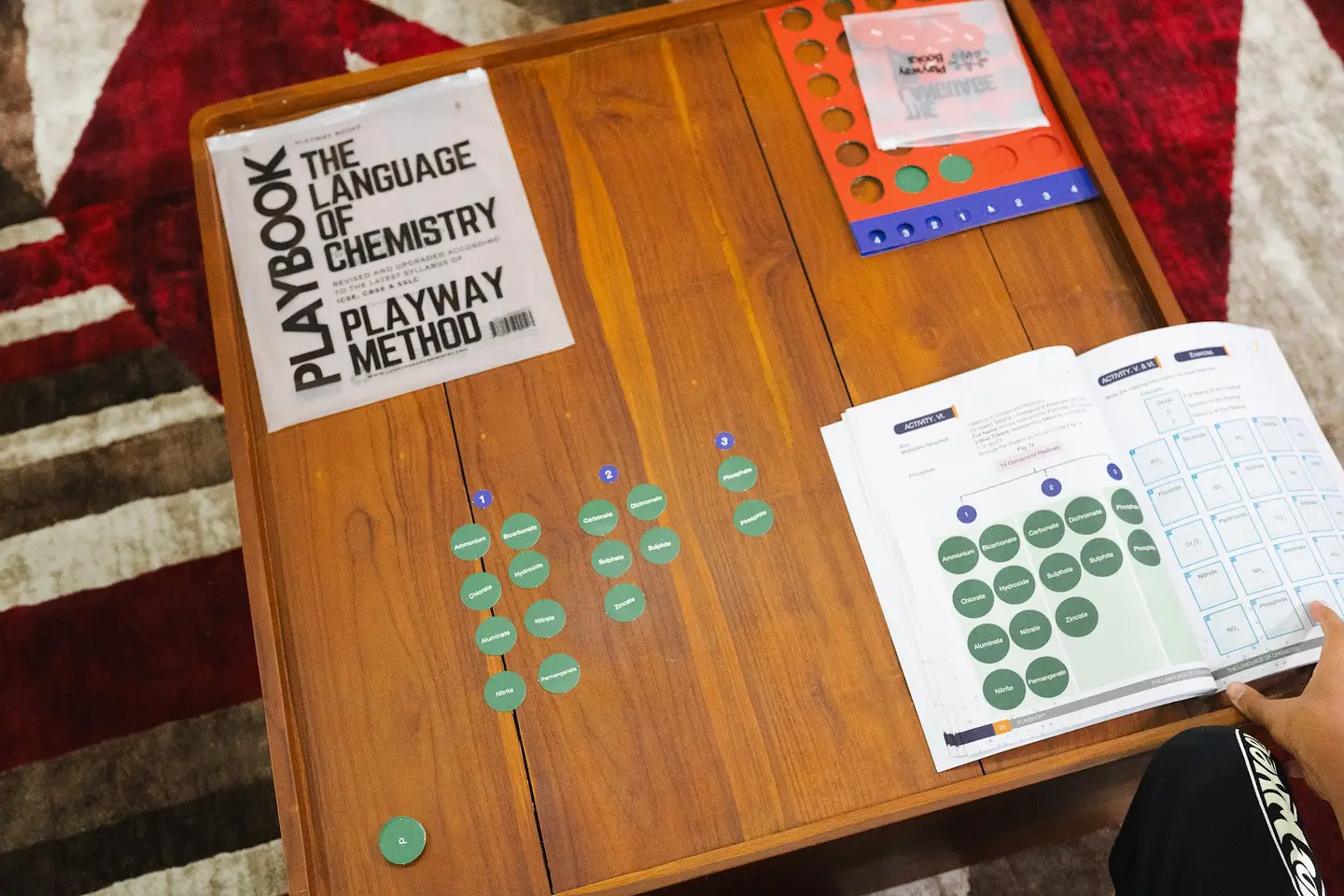
The Language of Chemistry, Playbook® is where those thirty elements and twenty-five radicals come as punch-out tokens — thirty red, twenty-five green and eight blue, on two sheets inside the book — with 6 activities and 12 exercises between the charts and the gate. Chapter II does not open until 172 of 184 are right, which is 93.5%. That is a standard, not a pass mark.
How two valencies become a formula.
Write the positive part first and the negative part second. Give each the other’s valency as its subscript, then reduce to the lowest terms. That is the whole rule, and it is Step II of the method.
Sodium 1 · Chloride 1
NaCl
Calcium 2 · Hydroxide 1
Ca(OH)2
Aluminium 3 · Sulphate 2
Al2(SO4)3
Iron [Ferric] 3 · Oxide 2
Fe2O3
Magnesium and oxide are both divalent, so magnesium oxide reduces to MgO and never Mg2O2. That reduction is the step most often skipped.
Where the rule stops
Of the formulas the three boards set, 8 are not built this way, and knowing which is part of knowing the rule. CO, NO2, SO2 and SO3 are covalent oxides in which the non-metal combines at a valency the chart does not carry — carbon at 2, nitrogen at 4, and sulphur at 4 and at 6. Fe3O4 carries iron in two states at once, ferrous and ferric together. CH3COOH and CH3OH are written as organic formulas, by the carbon chain rather than by two parts. CaOCl2 is bleaching powder, a mixed salt rather than one positive part and one negative one. Each is worked through on the formula index.
The metals with two valencies.
These are where marks are lost, and where a textbook question is sometimes unanswerable as printed. “Copper Sulphate” names no valency, so no formula can be worked out from it; Copper(II) Sulphate, or cupric sulphate, can be. The author’s notes on all three boards return to this.
It is why Chart I lists them twice over. Activity I puts it plainly: “Elements like Iron, Copper, Mercury and Lead show ‘Variable Valency’. Therefore, these Elements are represented with Two Tokens.” A student picking up a token for iron has already had to decide which iron they mean.
| Element | Lower | Called | Higher | Called |
|---|---|---|---|---|
| Iron Fe | 2 | Ferrous | 3 | Ferric |
| Copper Cu | 1 | Cuprous | 2 | Cupric |
| Mercury Hg | 1 | Mercurous | 2 | Mercuric |
| Lead Pb | 2 | Plumbous | 4 | Plumbic |
Questions
- What is valency?
- The combining capacity of an element, measured by the number of atoms of hydrogen one atom of it can combine with. It is the number you need before you can write a chemical formula, and it is what the criss-cross rule uses.
- What is the difference between a simple radical and a compound radical?
- A simple radical is one element carrying a charge — chloride, oxide, sulphide. A compound radical is a group of elements that combines as a single unit and keeps its own valency — sulphate, nitrate, ammonium, hydroxide. Splitting them apart is what stops a student guessing at formulas, and it is what the boards’ own textbooks do not do.
- Why do iron and copper have two valencies?
- Some metals combine in more than one ratio. Iron is divalent as ferrous and trivalent as ferric; copper is monovalent as cuprous and divalent as cupric. This is why “Iron Oxide” and “Copper Sulphate” are not answerable questions — without the state, the formula cannot be worked out. Fe2O3 is Iron(III) Oxide, or ferric oxide, and CuSO4 is Copper(II) Sulphate, or cupric sulphate.
- What is the valency of a permanganate radical?
- Permanganate, MnO4, is monovalent. It is a compound radical, so it takes a bracket when more than one of it appears in a formula.
- How do you write a chemical formula from valencies?
- Write the positive part first and the negative part second, then give each the other’s valency as its subscript and reduce to the lowest terms. Sodium and chloride are both monovalent, so sodium chloride is NaCl and no subscript appears at all — that is the book’s Example 1. Calcium is divalent and hydroxide is monovalent, so calcium hydroxide is Ca(OH)2. Magnesium and oxide are both divalent, so magnesium oxide is MgO and never Mg2O2.
This page is Step I. There are two more.
Alphabets, then words, then sentences. The alphabets are above; the formulas they build are Step II and the equations those build are Step III, and each has a reference page of its own on this site.