
For students · Classes 7 to 10 · ICSE / CBSE / SSLC
You probably understand chemistry. Writing it is the hard part.
Chemistry is a branch of science. It has a written language of its own — symbols, formulas, equations — and that is where the marks usually go. This book teaches that part, in three steps, with tokens you punch out and move around.
Start with the round below. It is one formula, built the way Chapter II builds every one of them, and it takes about thirty seconds. Nothing is scored and nothing is saved.
Token Play
Join a token to a token. Watch the formula appear.
One round, the way a student plays it on a table with the punch-out sheet from The Language of Chemistry.
Choose a token, then choose the slot it belongs in. One element, one radical, and the valency that joins them — only one of the three numbered tokens is right. The valency is how many the element combines as; it is not part of the finished formula. On a keyboard: tab to a token, press Enter to pick it up, then tab or arrow to a slot and press Enter to drop it. Escape puts it back.
On the bench
The join
Choose a token to begin.
NaCl
The valencies crossed over. Sodium combines as one and chloride combines as one, so one of each is all it takes — and a subscript of 1 is never written. This is the book's first worked example, on page 28.
That is one word in the language of chemistry. The book has 19 exercises and 279 questions like it, and the tokens come punched out on 2 sheets inside it.
What is actually going wrong.
You follow the reaction in class. Then the question comes and the answer has to be written down. A symbol, then a valency, then a formula, then a balanced equation.
That is a notation, and nobody set aside a week to teach it to you. Every board sets it in the examination — ICSE, CBSE and the Kerala SSLC. None of them stops to build it first. So the marks go missing somewhere between knowing the chemistry and writing it, and it looks like you did not understand the chapter.
You did. You were never taught the writing.
The method
Alphabets, words, sentences.
The same order a child learns to read in, applied to a subject that is normally taught as a list of facts to be remembered. Each step ends in a score, and below the score the step is repeated.
Step I
Alphabets
- Na
- Cl
The full name, symbol, formula and valency of thirty elements and twenty-five radicals — as tokens you can pick up.
Sodium = Na
172 of 184 — 93.5% — before Chapter II opens.
Step II
Words
- Na
- 1
- Cl
Chemical formula. Join an element to a radical using its valency — the join is the formula. Sodium is monovalent and so is chloride, so they join one to one.
NaCl
37 of 40 — 92.5% — before Chapter III opens.
Step III
Sentences
- Na
- 1
- Cl
Chemical equations. The equation written for a reaction has to balance, because a chemical change rearranges atoms and never makes or destroys one.
HClplus NaOH→ NaClplus H2O
51 of 55 to finish.
What you do, in five steps.
Every one of the 3 chapters runs the same loop — chart, activity, exercise, score, gate. Below each step is the thing not to do, because that is where most of it goes wrong.
Step 1 · Chart
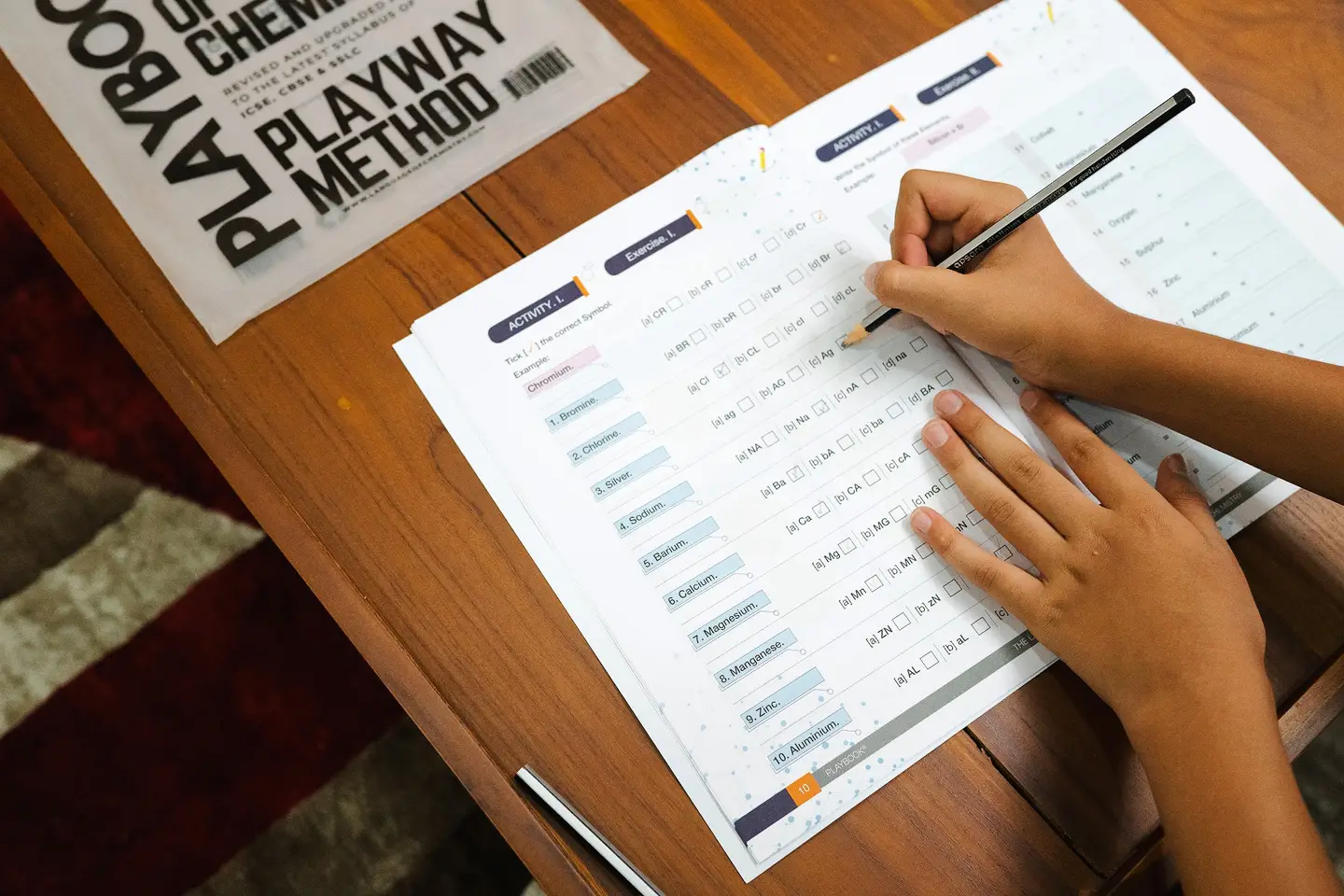
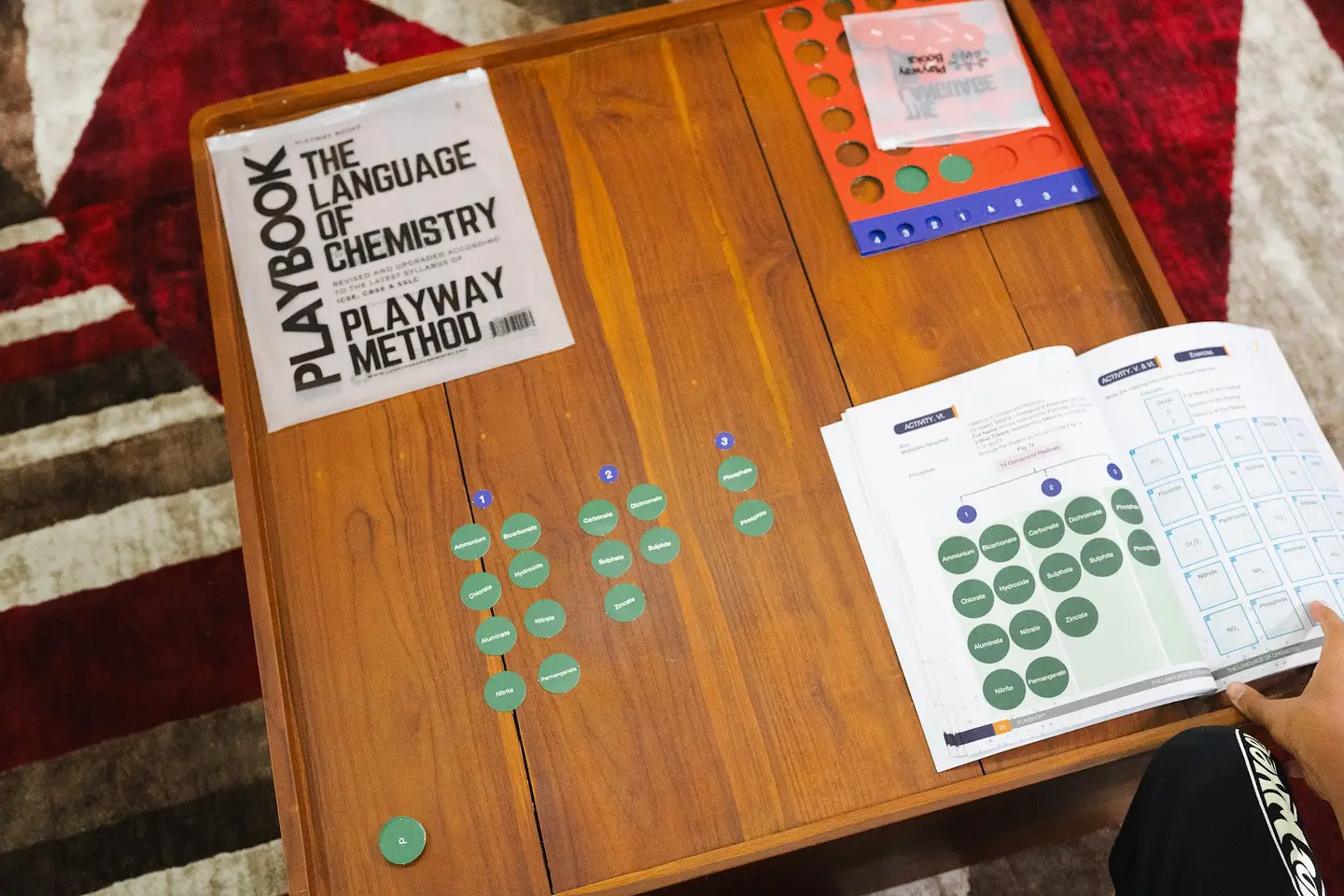
Punch out the tokens and keep the chart open beside you. Chapter I is thirty elements and twenty-five radicals, and they come on two sheets at the back of the book.
You are not memorising the chart first. You are going to use it until you stop needing it.
Step 2 · Activity
Build with the tokens before you write anything. There are 6 Activities in Chapter I — names and symbols first, then valencies, then sorting the radicals into simple and compound. Crossing the valencies over comes in Chapter II.
Do not skip to the writing because the tokens feel slow. The tokens are what make the writing fast later.
Step 3 · Exercise
Do one whole Exercise with the answers closed. There are 19 of them across the three chapters, and 279 questions in total.
Do not check an answer halfway through. An answer you looked up is not one you knew.
Step 4 · Score
Mark your own work against the answers in the book, then write the number on the evaluation chart on p111.
Do not round it up. The chart is only useful if it says where you actually are.
Step 5 · Gate
Compare your score to the gate. Chapter I closes at 172 out of 184. At or above it, Chapter II opens.
Below it, you do the whole set again. That is not a punishment. Chapter II asks you to write formulas, and you cannot write one while the valencies are still guesses.
You learn this by playing with the tokens, and the play is the whole of it — there are no points, no streaks, no badges and no leaderboards. The reward for getting a formula right is the formula being right. Chapter I closes at 93.5%, which is a standard, not a pass mark.
The part nobody tells you first.
This book will send you back. If you score below 172 out of 184, you do the whole set of Exercises again before Chapter II opens.
That is deliberate, and it is the reason it works. Chapter II asks you to write chemical formulas. You cannot write one while you are still guessing at valencies, so going on early buys a fortnight and costs the chapter.
It will not make chemistry easy, and it does not claim to. It makes the writing automatic, which is the thing the examination actually tests while you are watching the clock.
Five pages you can use right now, free.
Nothing on these is locked and none of them asks who you are. They are the reference set, in the order the three steps come in.
- Valency and radicals — Step I. Both of the book's charts in full: thirty elements and twenty-five radicals, with the valency of each.
- Chemical formulas — Step II. How the criss-cross works, and every formula the three boards set.
- Balancing equations — Step III. Worked step by step, with the atom count at each step.
- Practice sets — formulas to write and equations to balance, for your board, with the answers on the page so you can mark your own.
- Glossary — element, symbol, valency, radical, formula, coefficient, balanced equation, each with a worked example.
Questions
What students ask
I understand chemistry in class. Why do I still lose marks?
Usually because of the writing, not the chemistry. The reaction makes sense, and then the answer has to go down as a symbol, a valency, a formula and a balanced equation. Every board assumes that part. None of them teaches it. This book teaches it on purpose.
Do I have to memorise thirty elements and twenty-five radicals?
Not by sitting and staring at the chart. You use the tokens until you stop reaching for them. That is the whole difference between this and a list: you are building with the names and symbols, so the recall comes from having used them.
What happens if I score below the gate?
You repeat the whole set of Exercises for that chapter before the next one opens. Chapter I closes at 172 of 184, which is 93.5% — a standard, not a pass mark. It is the part of the book most worth not arguing with.
Is this instead of my school textbook?
No, and it does not follow your textbook chapter by chapter either. It teaches the notation underneath every chapter — symbols, valency, formulas, equations. You still need the textbook for the rest of the syllabus.
Do I need a phone, an app or an account?
No. Everything is in the printed book: both token sheets, all 19 Exercises, every answer, and the evaluation chart on p111. There is nothing to download, log into or subscribe to.
Is there anything I can try before anyone buys it?
Yes, and it is free. The round at the top of this page is the book’s own first example. The practice sets, the valency chart, the formula pages, the equation pages and the glossary are all on this site and all ungated.
Every question, including what is in the box and what it costs
If someone else is buying it.
Send them to For parents. It is the same book written as what an adult does at home, and it answers "I do not know any chemistry myself" — they do not need to. A teacher wants For teachers, and a school ordering copies wants For schools. One book covers Classes 7 to 10 across all three boards.
Look inside is the book itself — the charts, a token sheet and a page of Exercises, photographed.
Ready when you are.
There is no cart on this site. The Playbook ships from Amazon.in, Flipkart and JioMart, and it is on the shelf in Kerala — every store, with its own page, is one click away.