
For schools · ICSE / CBSE / SSLC
In classrooms since 1992. In print since 1996.
One book, for Classes 7 to 10, across ICSE, CBSE and Kerala SSLC. It teaches the symbols, valencies, formulas and equations your syllabus already tests. We send a sample copy to any school that asks.
The Language of Chemistry teaches the notation every board’s syllabus assumes and none of them sets aside time to teach. It was first used at St. Aloysius ISC School in Kochi in 1992 and printed from 1996. It was written by that school’s Head of Chemistry, who had marked ISC papers as an examiner for three years. Two examination bodies have written in appreciation of the method — CISCE in December 2002 and NCERT in July 2008.
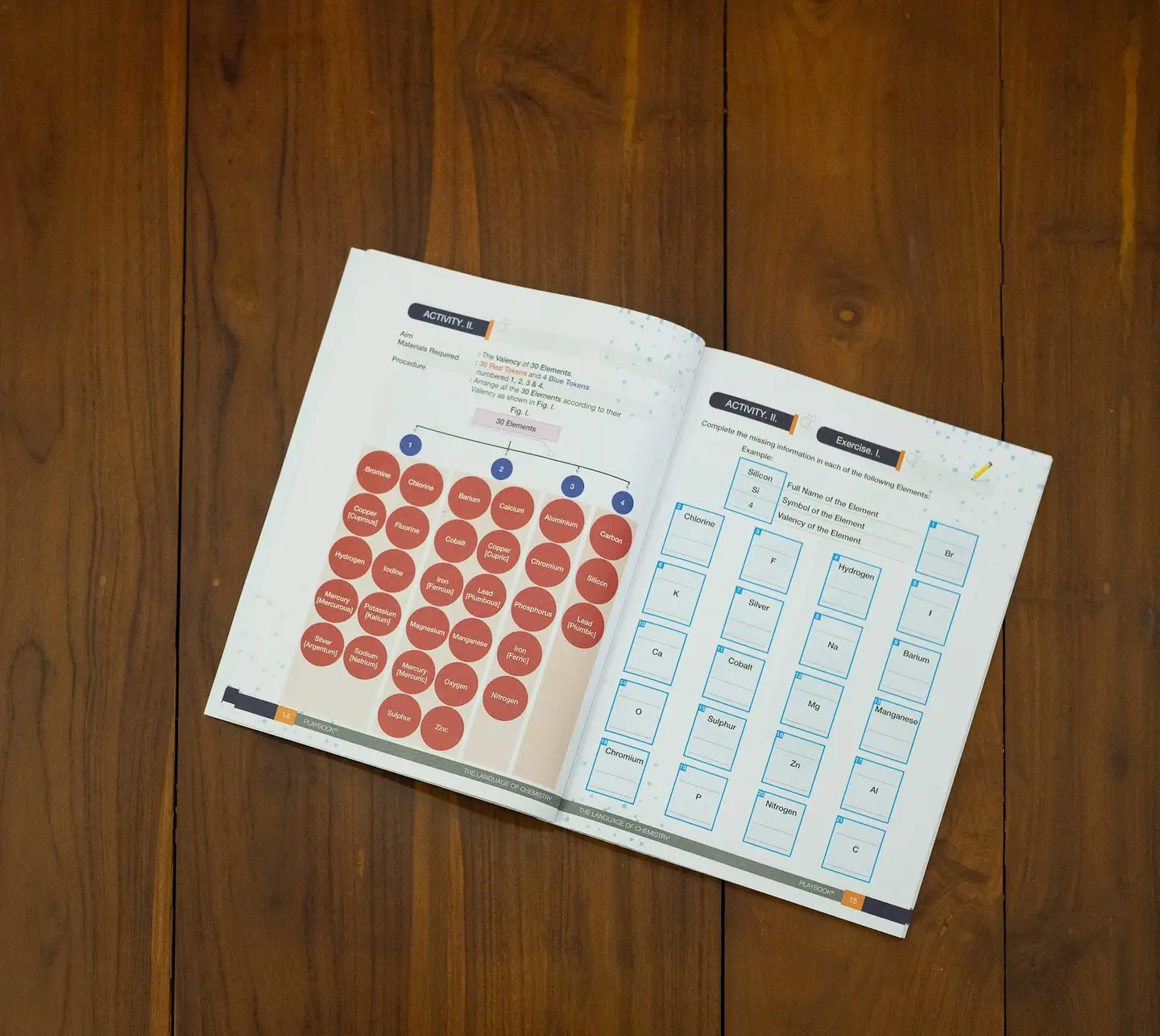
- A sample copy
- One per school, on request, with no obligation.
- Bulk pricing
- Quoted against your intake, not a list price.
- Syllabus mapping
- The book’s topics set against ICSE, CBSE and SSLC by class.
- Delivery before the year starts
- Printed and dispatched from Kochi. Tell us your intake date.
The book, in figures
112
Pages
2
Charts
6
Activities
19
Exercises
279
Questions
2
Token sheets
If you are not ordering for a school.
A parent buying a single copy wants For parents, which is the same method written as what an adult does at home. A teacher after classroom material rather than a quotation can read For teachers or take the practice sets — free, ungated, drawn from each board's own syllabus and printable as they are.
A tuition centre ordering for a batch can ask for bulk pricing on its own page, with the same one copy per student.
What was said about the method, and when
- CISCE
- 18 December 2002
- NCERT
- 1 July 2008
- Published since
- 1996
- ISBN
- 978-81-959241-0-3
“The Metro Kit developed by her will certainly help in making the basic concept of writing correct chemical formulas and balanced equations clearer to students.”
“Activities given in the manual are thought provoking.”
CISCE's is a letter of appreciation for the method. NCERT's is a set of comments on the method, which open by calling it a good attempt. Neither is accreditation, nor approval of the book as a prescribed text, nor current or ongoing. Each is set out on the About page, with how it came about.
Request a sample copy.
One copy per school, no obligation. Tell us your intake and we will quote bulk pricing and confirm a delivery date before you raise a purchase order.
Or just ring us.
The office is in Kochi and a person answers it. If that is quicker than a form, it is also fine by us — and it is the route to use if your school's computers do not run scripts.
Talk to us
- +91 99471 23678 Kochi office, weekdays
- WhatsApp +91 99471 23678
- learn@playwaybooks.com
43/2153, Jewel Homes
Flat E1, Whitefield, A-Block
SRM Road, Kaloor
Ernakulam, Kerala, India — 682018
- CIN
- U22220KL2022PTC074201
- GSTIN
- 32AAMCP6989J1ZN
The enquiry form
Your school, the board, the class, roughly how many copies, and how to reach you.
Or skip the form: ring +91 99471 23678 or write to learn@playwaybooks.com. A person in Kochi reads both, and an enquiry by telephone is exactly as welcome as one through the form.
What happens to this. We use it to answer your enquiry, send a sample copy and prepare a quotation — nothing else. It is not sold and it is not shared with an advertiser. The form is run for us by HubSpot on their European servers, so what you type is held by HubSpot as well as by Playway Books. And because the form is part of this page, HubSpot knows you opened it whether or not you write anything.
You can ask us to correct or erase it at any time, and withdraw your consent, by writing one line to learn@playwaybooks.com. The privacy policy lists who processes it, how long it is kept and the rights you have.
Please have a member of staff or a parent fill this in rather than a student — s. 9 of that Act governs the data of anyone under eighteen, and we would rather not hold any.
Against your syllabus
Every board asks for it before it teaches it.
The Playbook does not follow a board’s chapter order, and it is not a substitute for the textbook. It teaches the notation each board assumes a student already has — which, as each board’s own textbook shows, is assumed rather earlier than it is explained.
| ICSE Indian Certificate of Secondary Education | CBSE Central Board of Secondary Education | SSLC Secondary School Leaving Certificate, Kerala | |
|---|---|---|---|
| Chemistry starts | Class 6 | Class 7 | Class 8 |
| Classes covered | Classes 6 to 9 | Classes 7 to 10 | Classes 8 to 10 |
| Chemical formulas to write | Set by theme rather than enumerated | 79 listed | 52 listed |
| Chemical equations to write | Set by theme rather than enumerated | 70 listed | 51 listed |
| When writing them is taught | Symbol, valency, formula of radicals and balancing — Class 9 | Writing a formula — Class 9. Writing and balancing an equation — Class 10. | Writing a formula — Class 9. |
ICSE — the gap
The Council’s own annual Pupils Performance Analysis identifies writing symbols, chemical formulas and balanced equations as a persistent difficulty.
CBSE — the gap
Formulas appear from Class 7 and equations from Class 7, but writing a formula is not explained until Class 9 and balancing not until Class 10.
SSLC — the gap
Balancing equations is explained in Class 8, Part I, Chapter IV, before a chemical formula or a chemical equation has been explained at all.
Questions
What a head of department needs to answer internally.
Can a school get a sample copy before ordering?
Yes. Playway Books sends one sample copy per school on request, with no obligation. Use the enquiry form on the For Schools page or ring the Kochi office on +91 99471 23678 — a school that would rather talk than fill in a form is not a lesser enquiry.
Does the Playbook map to our board’s syllabus?
The Playbook teaches chemical notation, which ICSE, CBSE and SSLC all assume rather than teach. The mapping table on the For Schools page sets the book’s topics against all three boards by class level, and it is written to print cleanly so a head of department can forward it internally.
What are the CISCE and NCERT letters?
CISCE’s is a letter of appreciation for the method, dated 18 December 2002. NCERT’s is a set of comments on the method from its Department of Education in Science and Mathematics, dated 1 July 2008, which open by calling it a good attempt. Neither is accreditation and neither is an approval of the book as a prescribed text, and Playway Books does not describe them as either. The book’s own back cover credits them to “the ICSE Board” and “the CBSE Board”, which is wrong on both counts and is due to be corrected in the next print run; the preface has it right. Both letters are set out on the About page, with how each came about. The NCERT letter runs to six numbered points and the site publishes three of them.
Can a school photocopy the Playbook for a class?
No — and the first reason is practical rather than legal. The Playbook is consumable: 2 sheets of tokens are punched out of it and handled, 19 exercises are written in and marked against the answers enclosed at the back, and the evaluation chart is filled in as a student goes. A photocopy carries none of that, so a class working from photocopied sheets is doing a worse exercise than the one the book sets. A school that cannot buy a copy per student should ring the Kochi office on +91 99471 23678 about bulk pricing rather than photocopy — that is a shorter conversation than it sounds. What may be used without asking, what needs permission, and the law it sits under are set out on the copyright and permissions page.
Can you deliver before the academic year starts?
Yes, when the order is placed with enough notice. Bulk orders are printed and dispatched from Kochi, so the constraint is the print run rather than a warehouse — tell us your intake date on the enquiry form and we will confirm a date before you raise a purchase order.
Every question, including what is in the box and what it costs