
Comparison · ICSE / CBSE / SSLC · Classes 7 to 10
Three books. Three different jobs.
A textbook explains the chemistry. A guide book explains the textbook. A Playbook teaches the notation both of them assume a student already has. You will probably need more than one of the three.
That notation is symbols, valency, formulas and equations, and the Playbook refuses to move on until it has been learned to a score. The three are not substitutes for one another. This page is about which problem you are actually solving.
What it is, and what it is not.
The last two rows are the honest ones. The Playbook is not a substitute for the textbook and does not follow your board’s chapter order — it teaches the language every chapter is written in.
| A textbook | A guide book | The Playbook | |
|---|---|---|---|
| Teaches the notation itself | Assumes it | Assumes it | Teaches it |
| Drills to mastery | No | Some practice | 19 exercises, 279 questions |
| Gates progress on a score | No | No | Yes — 172 of 184, then 37 of 40, then 51 of 55 |
| Answers included | Usually not | Yes | Yes, all of them |
| Is played with objects | No | No | Yes — 2 punch-out token sheets |
| Follows your board’s chapter order | Yes | Yes | No — it is ordered by the language, not the syllabus |
| Covers the full syllabus | Yes | Yes | No — it covers the notation the syllabus assumes |
Row by row.
Seven rows, in the order of the table above. Two of them the Playbook loses, and those two are the ones worth reading first if you are deciding between categories rather than between books.
Teaches the notation itself
A textbook explains a reaction and writes it down in symbols on the assumption that the symbols are already known. A guide book does the same thing again, more briefly. Neither one goes back and builds the notation, because neither one is scheduled to — the syllabus has already moved on. The Playbook does nothing else: Chapter I is thirty elements and twenty-five radicals and their valencies, and it does not reach a reaction at all.
Drills to mastery
A guide book gives practice; the difference is what happens to the practice afterwards. Here there are 19 Exercises and 279 questions, every answer is enclosed, and the score is written on an evaluation chart on p111. Practice that is not scored is reading.
Gates progress on a score
This is the row no other category has. Chapter I does not open onto Chapter II below 172 of 184 — 93.5% — and a student underneath it repeats the whole set of Exercises. A guide book cannot do this and would not want to: it is bought to get through a chapter, not to be stopped in one.
Answers included
Guide books include answers, so this row is not a win. What differs is the reason: here the answers are enclosed so the student can mark their own work against the evaluation chart, which is the only way the gate can be applied at all. A parent who never studied chemistry can still run it.
Is played with objects
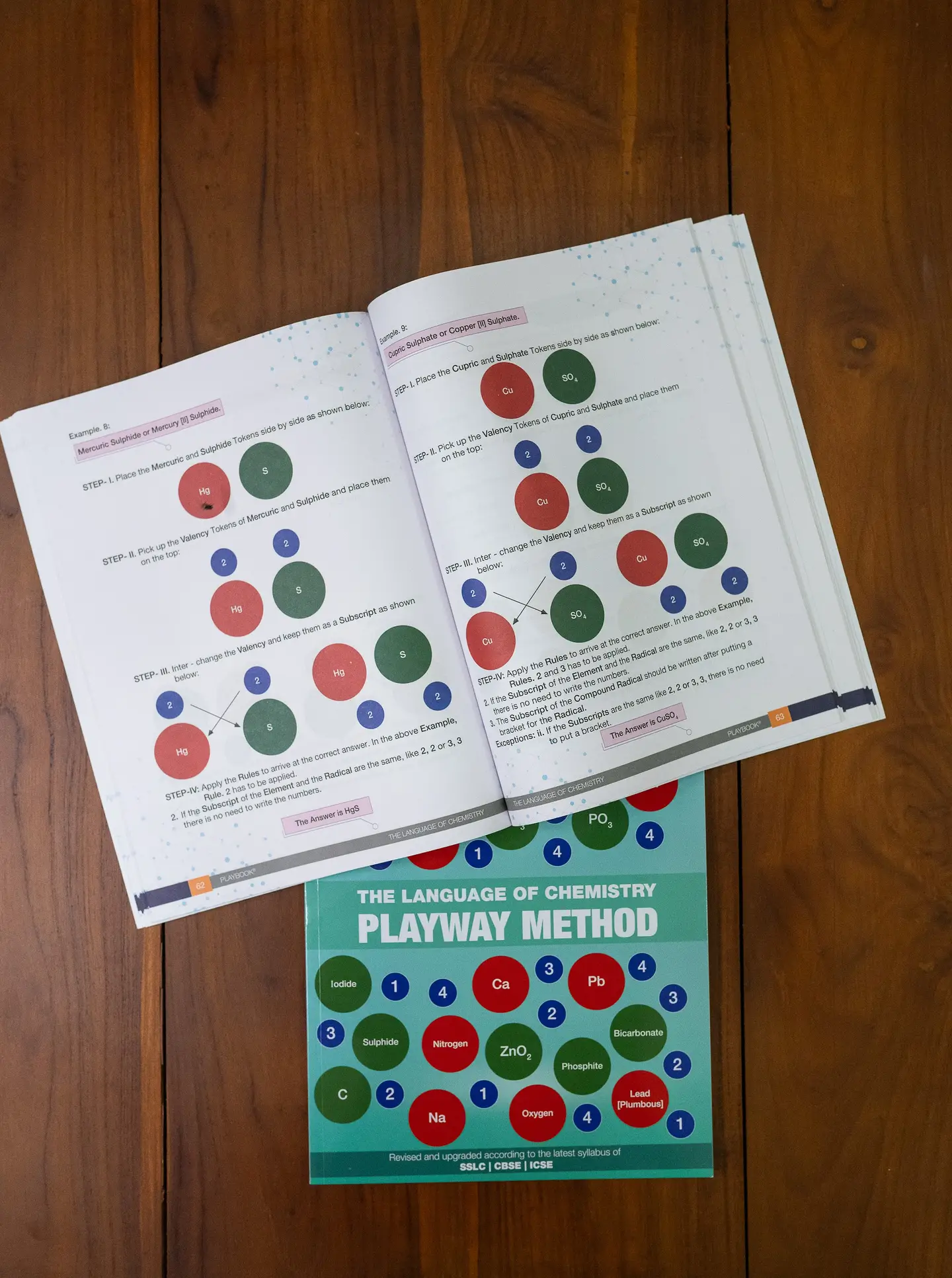
Thirty elements and twenty-five radicals come die-cut on 2 sheets and push out of the back of the book. A formula is built by putting the positive part down, the negative part beside it, and crossing the valencies over — with the hands, before the pen. It is also the reason this is a printed book and not an app.
Follows your board’s chapter order
It does not, and it is not trying to. It is ordered by the language — alphabets, then words, then sentences — which cuts across every board’s chapter order by design. If what you want is something that runs beside the syllabus week by week, that is a guide book, and this is not one.
Covers the full syllabus
It does not do that either. It covers the notation the syllabus assumes: about 94 formulas and 105 equations set across the ICSE, CBSE and Kerala SSLC syllabuses. Everything else in the subject — periodicity, bonding, the reactions themselves — is the textbook's, and stays there.
The two rows it loses.
It does not follow your board's chapter order, and it does not cover the full syllabus. Both are true, both are printed in the table above, and neither is a defect being managed — they are consequences of the one decision the book makes.
That decision is to teach the language rather than the syllabus. A book ordered by the language runs alphabets, then words, then sentences, and a book ordered by the syllabus runs whatever chapter comes next in April. You cannot have both orders in one book, and the language is the order that transfers: a student who can write Ca(OH)2 can write it in ICSE, in CBSE and in the Kerala SSLC exam, in Class 8 and in Class 10.
So the honest position is that a household buying this book will still own the textbook, and may well still own a guide book. What it will stop owning is the problem where a child understands the reaction and loses the mark anyway.
Does it replace the school textbook?
No. The textbook is prescribed and this is not, and nothing here is written to be handed in. What it replaces is the assumption sitting underneath the textbook — that a student arriving at Chapter III already knows how a formula is written. Each board's own inventory of what it sets, and when it explains it, is on the syllabus pages: every one of them sets formulas and equations before the textbook explains how one is written, and the Kerala SSLC syllabus sets balancing a year before either.
Questions
What people ask before they choose
Is a Playbook just a workbook with a different name?
No. A workbook is where the answers are written down. This is where a formula is built out of punch-out tokens before it is written down at all, and where the chapter does not open until the score is made. The tokens and the gate are the two things a workbook does not have.
Should I buy this instead of a guide book?
Only if the problem is the notation. If your child understands the chapter but cannot write the formula or balance the equation, this is the book. If they have not understood the chapter, a guide book on that chapter is the more useful purchase, and the two do not compete.
Is it comprehensive enough for the board exam?
Not on its own, and it does not claim to be. It teaches the notation the exam is written in — about 94 formulas and 105 equations across the three syllabuses — and it teaches it to a standard: 172 of 184 before Chapter II opens. The rest of the syllabus is the textbook's job.
Which competitor is this table comparing against?
None by name. The comparison is against two categories — the prescribed textbook and the general category of guide books and question banks — because naming a publisher would make this an advertisement rather than a description.
What is inside The Language of Chemistry, Playbook?
112 pages in 3 chapters, with 2 punch-out token sheets carrying thirty elements and twenty-five radicals. Inside: 2 charts, 6 activities, 19 exercises and 279 questions. The answers to all 19 exercises are enclosed and there is an evaluation chart at the back, so the book marks itself.
How much does the Playbook cost?
The published price is ₹399. Retailers set their own — check Amazon.in, Flipkart and JioMart for what they are charging today. ISBN 978-81-959241-0-3.
Where can I buy the Playbook?
Amazon.in, Flipkart and JioMart carry it online. In Kerala it is on the shelf at H&C Books, Ernakulam, and with other local stockists — ring the Kochi office on +91 99471 23678 and we will name the nearest one. Playway Books does not sell from this website; there is no cart here and the order goes through a retailer.
Why is it called a Playbook rather than a workbook?
A workbook is where you write the answers down. A Playbook is where you play a round, and the tokens come punched out of the back of it — because chemistry is something you do with your hands before you do it with a pen. The tokens are the reason the book exists in print rather than as an app.
Does the Playbook replace the school textbook?
No, and it does not follow a board’s chapter order either. It teaches the notation every board assumes a student already has — symbols, valency, chemical formulas and balanced equations — which each board’s own textbook sets in exercises before it explains. The syllabus pages list exactly what each board asks for, chapter by chapter.
Every question, including what is in the box and what it costs
Ready when you are.
There is no cart on this site. The Playbook ships from Amazon.in, Flipkart and JioMart, and it is on the shelf in Kerala — every store, with its own page, is one click away.