
For tuition centres · Classes 7 to 10 · ICSE / CBSE / SSLC
Chemistry books for tuition centres: a batch that starts with the notation.
The Language of Chemistry, Playbook® is a chemistry book for tuition centres teaching Classes 7 to 10 under ICSE, CBSE and SSLC. Students build each formula from punch-out tokens before they write it, mark themselves against printed answers, and repeat a chapter that falls short. One copy per student; bulk pricing is quoted on your intake.
Play the round below before you read any further. It is the first formula Chapter II works, built the way every later one is.
Token Play
Join a token to a token. Watch the formula appear.
One round, the way a student plays it on a table with the punch-out sheet from The Language of Chemistry.
Choose a token, then choose the slot it belongs in. One element, one radical, and the valency that joins them — only one of the three numbered tokens is right. The valency is how many the element combines as; it is not part of the finished formula. On a keyboard: tab to a token, press Enter to pick it up, then tab or arrow to a slot and press Enter to drop it. Escape puts it back.
On the bench
The join
Choose a token to begin.
NaCl
The valencies crossed over. Sodium combines as one and chloride combines as one, so one of each is all it takes — and a subscript of 1 is never written. This is the book's first worked example, on page 28.
That is one word in the language of chemistry. The book has 19 exercises and 279 questions like it, and the tokens come punched out on 2 sheets inside it.
What is in the box
A Playbook is not a book. It contains a game.
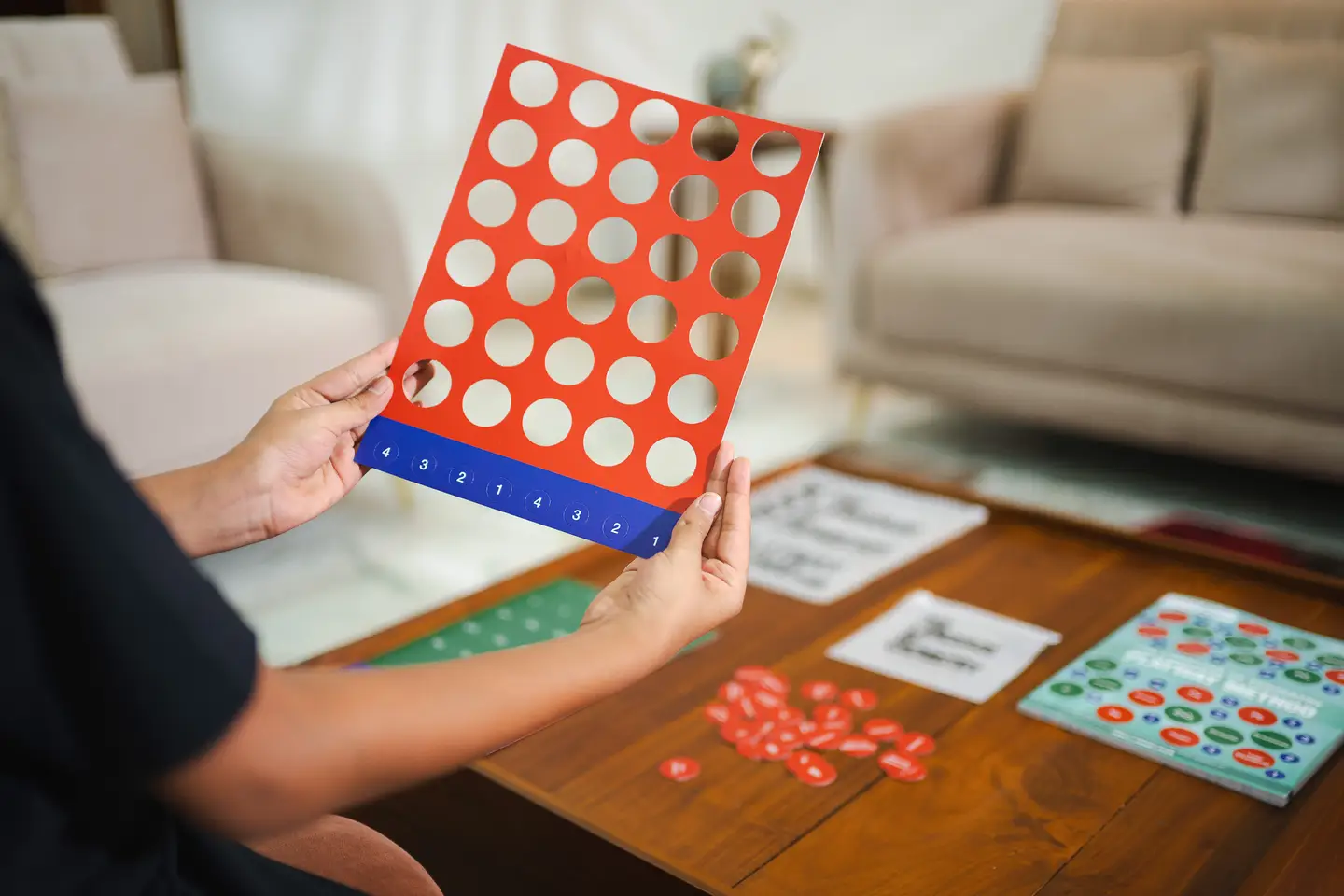
2 punch-out token sheets
Thirty elements, twenty-five radicals and the valencies that join them, printed and die-cut so a student pushes them out and puts them on a table. The word on each token is the code, and the colour repeats it — an element, a radical, a valency. A radical carries an inner ring as well, so the three types stay apart on a photocopy and for a reader who cannot separate the red from the green.
- Na
- 1
- Cl
The three types are told apart by what they carry and how they are drawn, not by colour — a radical carries a ring, a valency is smaller and set in figures.
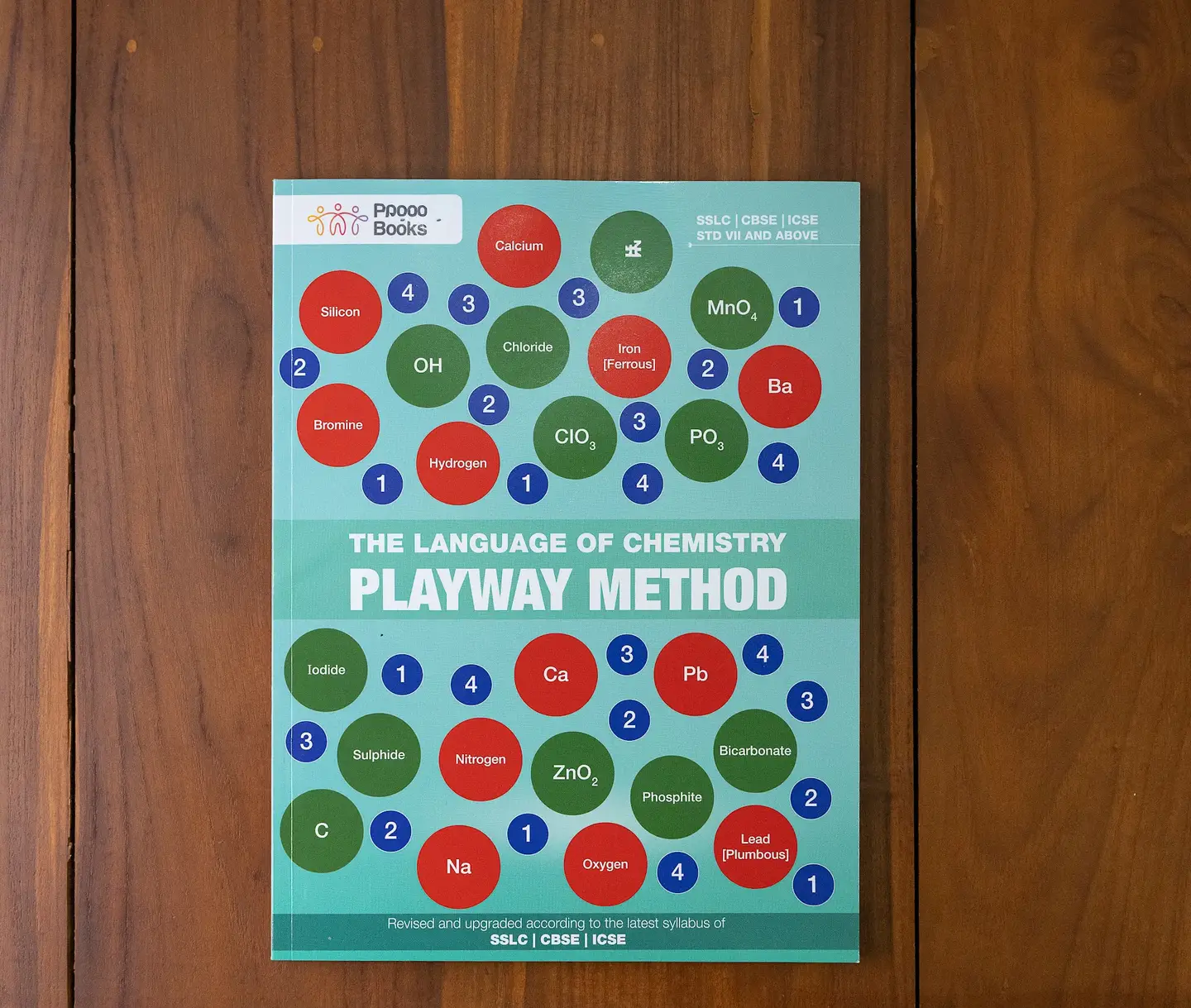
112 pages
The method, the charts, the activities and the exercises — in the order a student works through them.
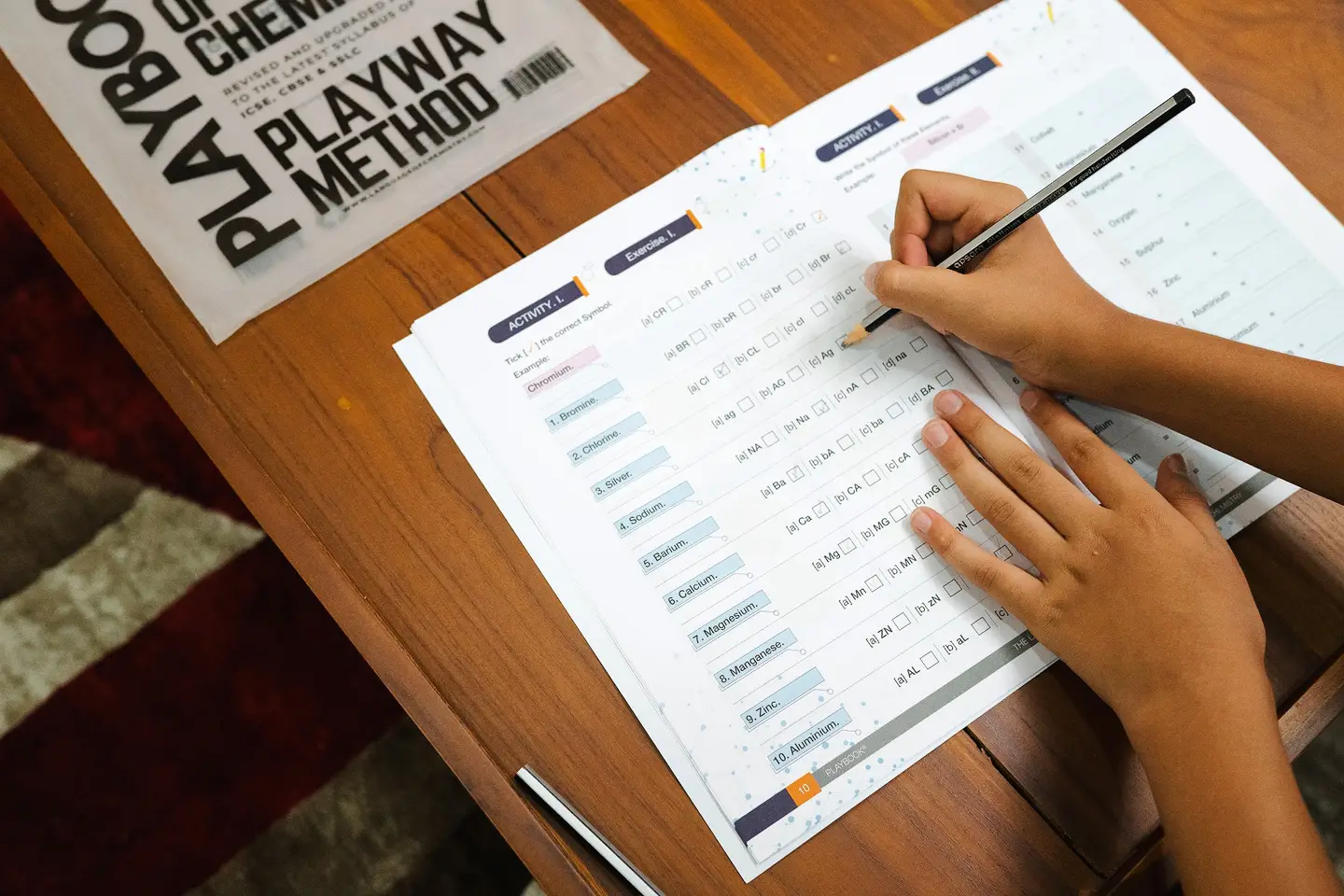
19 exercises, 279 questions
Across 6 activities and 2 charts. Enough repetition for the notation to become automatic, which is the entire point of drilling a language.
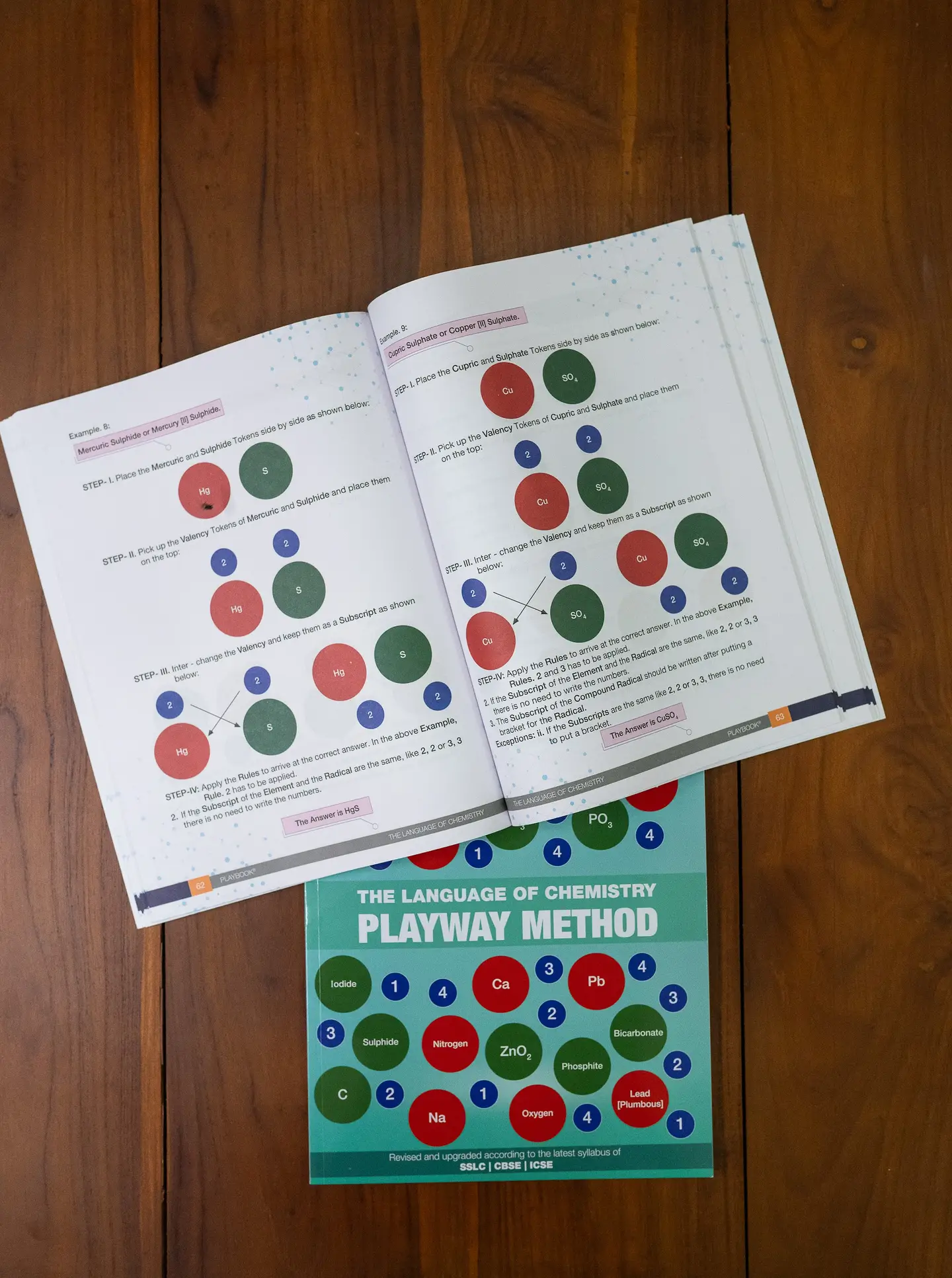
All answers enclosed
The book marks itself. A parent who never studied chemistry can still check the work, and nothing is held back for a separate guide.
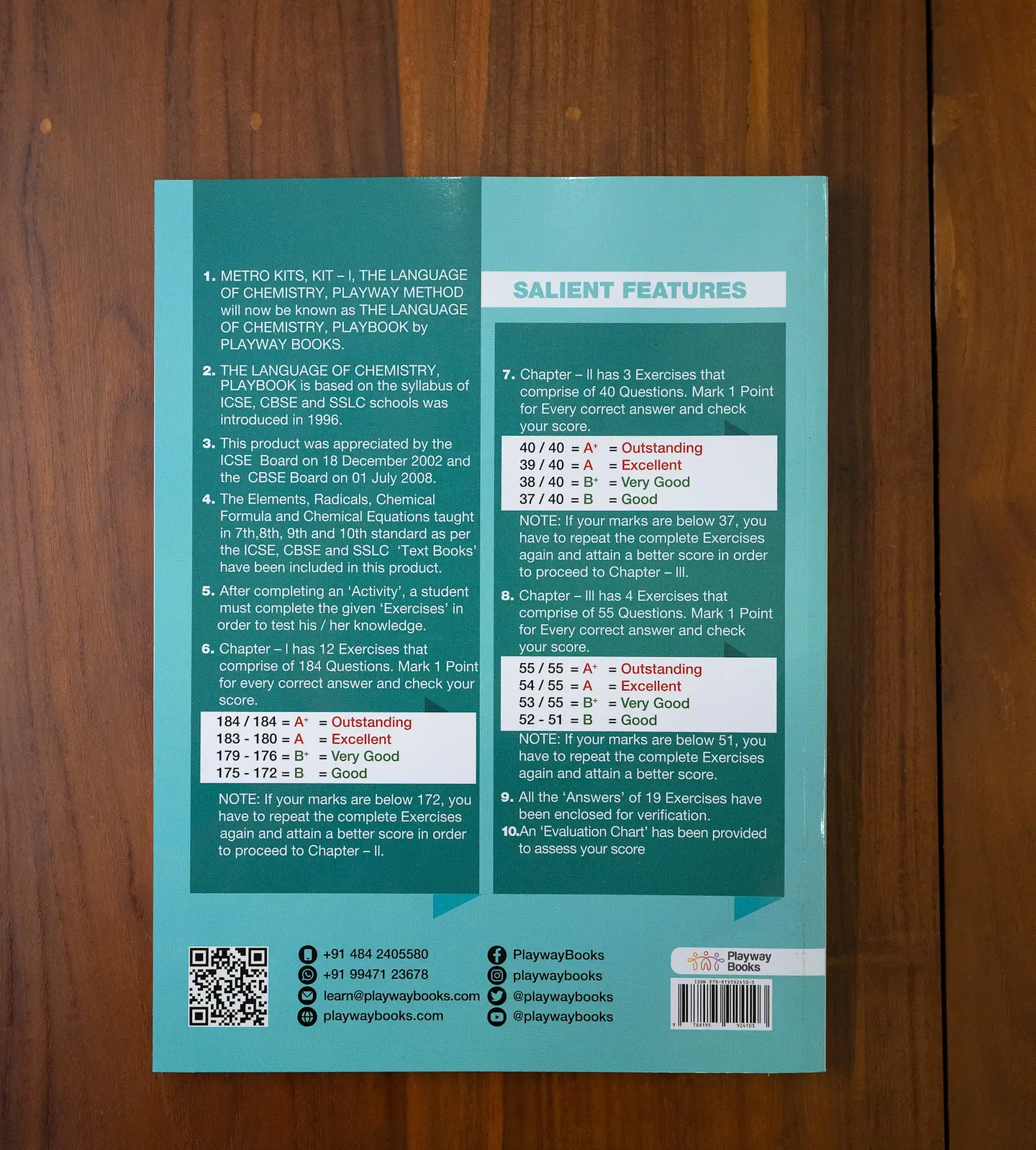
Evaluation chart
Scores are read against a chart, because the chapter gate is a number and not an opinion.
How does a batch use it?
Each student works from their own copy. They punch out the tokens, build the formula the chapter asks for, mark the Exercise against the answers enclosed in the book, and write the score on the evaluation chart. The gate decides whether a student moves on, so the batch does not have to move at one pace. Read how the method works.
CISCE wrote a letter of appreciation for the method on 18 December 2002. It is an appreciation, not accreditation, and not approval of the book as a prescribed text.
The method
Alphabets, words, sentences.
The same order a child learns to read in, applied to a subject that is normally taught as a list of facts to be remembered. Each step ends in a score, and below the score the step is repeated.
Step I
Alphabets
- Na
- Cl
The full name, symbol, formula and valency of thirty elements and twenty-five radicals — as tokens you can pick up.
Sodium = Na
172 of 184 — 93.5% — before Chapter II opens.
Step II
Words
- Na
- 1
- Cl
Chemical formula. Join an element to a radical using its valency — the join is the formula. Sodium is monovalent and so is chloride, so they join one to one.
NaCl
37 of 40 — 92.5% — before Chapter III opens.
Step III
Sentences
- Na
- 1
- Cl
Chemical equations. The equation written for a reaction has to balance, because a chemical change rearranges atoms and never makes or destroys one.
HClplus NaOH→ NaClplus H2O
51 of 55 to finish.
The gate
The book sends a student back. On purpose.
Each chapter ends in a score read against a chart at the back. Below the threshold the whole set of exercises is repeated before the next chapter opens. Chapter I closes at 93.5%, which is a standard, not a pass mark.
Chapter I · Alphabets
172 / 184
93.5% to proceed
Chapter II · Words
37 / 40
92.5% to proceed
Chapter III · Sentences
51 / 55
92.7% to proceed
What does game-based mean here?
Game-based here means the student does the joining: a token picked up and joined to another, sodium to chloride, valency 1 to 1, and the formula is what is left on the table. That is the whole game. The reward is a correct formula. There are no points, streaks, badges or leaderboards, and no promise that the subject gets lighter. The notation becomes something a student does with their hands before they write it.
Against your syllabus
Every board asks for it before it teaches it.
The Playbook does not follow a board’s chapter order, and it is not a substitute for the textbook. It teaches the notation each board assumes a student already has — which, as each board’s own textbook shows, is assumed rather earlier than it is explained.
| ICSE Indian Certificate of Secondary Education | CBSE Central Board of Secondary Education | SSLC Secondary School Leaving Certificate, Kerala | |
|---|---|---|---|
| Chemistry starts | Class 6 | Class 7 | Class 8 |
| Classes covered | Classes 6 to 9 | Classes 7 to 10 | Classes 8 to 10 |
| Chemical formulas to write | Set by theme rather than enumerated | 79 listed | 52 listed |
| Chemical equations to write | Set by theme rather than enumerated | 70 listed | 51 listed |
| When writing them is taught | Symbol, valency, formula of radicals and balancing — Class 9 | Writing a formula — Class 9. Writing and balancing an equation — Class 10. | Writing a formula — Class 9. |
ICSE — the gap
The Council’s own annual Pupils Performance Analysis identifies writing symbols, chemical formulas and balanced equations as a persistent difficulty.
CBSE — the gap
Formulas appear from Class 7 and equations from Class 7, but writing a formula is not explained until Class 9 and balancing not until Class 10.
SSLC — the gap
Balancing equations is explained in Class 8, Part I, Chapter IV, before a chemical formula or a chemical equation has been explained at all.
How does a tuition centre buy?
It is one chemistry title, not a catalogue, and one copy per student. A photocopy has no punch-out tokens in it, and the tokens are the book, so a batch working from photocopies is doing a different and weaker exercise; copying for a batch needs permission, so ask the office first. Bulk pricing is quoted against your intake, and one sample copy goes to the centre on request. The invoice comes from the Ernakulam office.
A centre may say it teaches from the book and name it correctly. It may not use the Playway name or marks for itself, or suggest that Playway Books approves, accredits or supplies it. There is no licence and no partner scheme. The copyright page and the trade marks page set out both in full.
For one copy rather than a batch, find a retailer or a stockist.
Questions
What tuition centres ask before they order.
What does a tuition centre receive?
One Playbook per student: 112 pages in 3 chapters, 2 sheets of punch-out tokens, 19 Exercises with every answer enclosed, and an evaluation chart on p111. There is nothing to download, print or log into.
May a centre photocopy the Playbook for a batch?
Not without permission. A photocopy has no punch-out tokens in it, and the tokens are the book — which is why one copy per student is how it is designed and priced. If a copy for every student is out of reach, ring the office rather than photocopy: there is bulk pricing.
How is bulk pricing set?
It is quoted against your intake, not read off a list. Tell us the board, the classes and roughly how many copies on the enquiry form, and a person in Kochi replies with a quotation before you raise a purchase order.
Which boards and classes does one book cover?
Classes 7 to 10, across ICSE, CBSE and SSLC. The syllabus pages set the book’s topics against each board’s own, class by class.
Do tuition centers get a different book from schools?
No. It is the same Playbook. What differs is only who orders it: a centre asks for a sample copy and bulk pricing through its own page, and is invoiced from the Ernakulam office as a school is.
May a centre say it teaches from the Playbook?
Yes, and name the book correctly. A centre may not use the Playway name or marks as its own — in a centre name, a batch name, a domain or as an advertising keyword — or suggest that Playway Books approves, accredits or supplies it. There is no licence, partner badge or centre scheme.
Can a centre have a sample copy first?
Yes. Playway Books sends one sample copy per centre on request, with no obligation. Use the enquiry form on this page or ring the Kochi office on +91 99471 23678.
Can you deliver before a batch starts?
Yes, when the order is placed with enough notice. Bulk orders are printed and dispatched from Kochi, so the constraint is the print run rather than a warehouse — tell us your start date on the enquiry form and we will confirm a date before you raise a purchase order.
Every question, including what is in the box and what it costs
Ask for bulk pricing and a sample copy.
One sample copy per centre, no obligation. Tell us your batches and roughly how many students, and we will quote bulk pricing and confirm a delivery date before you raise a purchase order.
Or just ring us.
The office is in Kochi and a person answers it. If that is quicker than a form, it is also fine by us — and it is the route to use if your centre's computers do not run scripts.
Talk to us
- +91 99471 23678 Kochi office, weekdays
- WhatsApp +91 99471 23678
- learn@playwaybooks.com
43/2153, Jewel Homes
Flat E1, Whitefield, A-Block
SRM Road, Kaloor
Ernakulam, Kerala, India — 682018
- CIN
- U22220KL2022PTC074201
- GSTIN
- 32AAMCP6989J1ZN
The enquiry form
Your centre, the board, the classes, roughly how many copies, and how to reach you.
Or skip the form: ring +91 99471 23678 or write to learn@playwaybooks.com. A person in Kochi reads both, and an enquiry by telephone is exactly as welcome as one through the form.
What happens to this. We use it to answer your enquiry, send a sample copy and prepare a quotation — nothing else. It is not sold and it is not shared with an advertiser. The form is run for us by HubSpot on their European servers, so what you type is held by HubSpot as well as by Playway Books. And because the form is part of this page, HubSpot knows you opened it whether or not you write anything.
You can ask us to correct or erase it at any time, and withdraw your consent, by writing one line to learn@playwaybooks.com. The privacy policy lists who processes it, how long it is kept and the rights you have.
Please have a member of staff or a parent fill this in rather than a student — s. 9 of that Act governs the data of anyone under eighteen, and we would rather not hold any.