
Reference · Step II · ICSE / CBSE / SSLC
A formula is a word. These are the words the boards set.
Every chemical formula your board sets, and the two parts each one is made from. Look one up, or work it out yourself. This is Step II of three — you need the valencies from Step I first.
A formula is written by putting the positive part first and the negative part second, then giving each one the other's valency as its subscript and reducing to the lowest terms. Every formula below carries the two parts it is built from, so the derivation is on the page rather than in a rule you have to remember.
These derivations are computed, not asserted. All 94 formulas the three boards set are run through the criss-cross rule on every build of this site; 86 come out exactly as printed, and the 8 that do not are named lower down with the reason. The valency chart is the other half of this page: it holds the parts, this holds what they build.
Every formula, and where it comes from.
Sorted by name. The two middle columns are the derivation — the positive part with its valency, the negative part with its. Where the rule does not build the formula, the column says so and the reason is below.
| Name | Formula | Positive part | Negative part | Set by |
|---|---|---|---|---|
| Acetic Acid | CH3COOH | Not built by the rule | — | CBSE |
| Aluminium Chloride | AlCl3 | Aluminium · 3 | Chloride · 1 | CBSE, SSLC |
| Aluminium Hydroxide | Al(OH)3 | Aluminium · 3 | Hydroxide · 1 | SSLC |
| Aluminium Oxide | Al2O3 | Aluminium · 3 | Oxide · 2 | CBSE, SSLC |
| Aluminium Sulphate | Al2(SO4)3 | Aluminium · 3 | Sulphate · 2 | CBSE, SSLC |
| Ammonium Chloride | NH4Cl | Ammonium · 1 | Chloride · 1 | CBSE, SSLC |
| Ammonium Hydroxide | NH4OH | Ammonium · 1 | Hydroxide · 1 | SSLC |
| Ammonium Sulphate | (NH4)2SO4 | Ammonium · 1 | Sulphate · 2 | CBSE |
| Barium Bromide | BaBr2 | Barium · 2 | Bromide · 1 | CBSE |
| Barium Chloride | BaCl2 | Barium · 2 | Chloride · 1 | CBSE, SSLC |
| Barium Iodide | BaI2 | Barium · 2 | Iodide · 1 | CBSE |
| Barium Sulphate | BaSO4 | Barium · 2 | Sulphate · 2 | CBSE, SSLC |
| Bleaching Powder | CaOCl2 | Not built by the rule | — | CBSE |
| Calcium Bicarbonate | Ca(HCO3)2 | Calcium · 2 | Bicarbonate · 1 | CBSE |
| Calcium Carbonate | CaCO3 | Calcium · 2 | Carbonate · 2 | CBSE, SSLC |
| Calcium Chloride | CaCl2 | Calcium · 2 | Chloride · 1 | CBSE, SSLC |
| Calcium Hydroxide | Ca(OH)2 | Calcium · 2 | Hydroxide · 1 | CBSE, SSLC |
| Calcium Nitrate | Ca(NO3)2 | Calcium · 2 | Nitrate · 1 | CBSE |
| Calcium Oxide | CaO | Calcium · 2 | Oxide · 2 | CBSE, SSLC |
| Calcium Sulphate | CaSO4 | Calcium · 2 | Sulphate · 2 | SSLC |
| Carbon Chloride | CCl4 | Carbon · 4 | Chloride · 1 | CBSE |
| Carbon Dioxide | CO2 | Carbon · 4 | Oxide · 2 | CBSE, SSLC |
| Carbon Monoxide | CO | Not built by the rule | — | CBSE, SSLC |
| Copper [Cupric] Carbonate | CuCO3 | Copper [Cupric] · 2 | Carbonate · 2 | CBSE |
| Copper [Cupric] Chloride | CuCl2 | Copper [Cupric] · 2 | Chloride · 1 | CBSE |
| Copper [Cupric] Hydroxide | Cu(OH)2 | Copper [Cupric] · 2 | Hydroxide · 1 | CBSE |
| Copper [Cupric] Oxide | CuO | Copper [Cupric] · 2 | Oxide · 2 | CBSE |
| Copper One Oxide | Cu2O | Copper [Cuprous] · 1 | Oxide · 2 | CBSE |
| Copper One Sulphide | Cu2S | Copper [Cuprous] · 1 | Sulphide · 2 | CBSE |
| Copper Two Nitrate | Cu(NO3)2 | Copper [Cupric] · 2 | Nitrate · 1 | CBSE, SSLC |
| Copper Two Sulphate | CuSO4 | Copper [Cupric] · 2 | Sulphate · 2 | CBSE, SSLC |
| Hydrochloric Acid | HCl | Hydrogen · 1 | Chloride · 1 | CBSE, SSLC |
| Hydrogen Carbonate | H2CO3 | Hydrogen · 1 | Carbonate · 2 | SSLC |
| Hydrogen Nitrate | HNO3 | Hydrogen · 1 | Nitrate · 1 | CBSE, SSLC |
| Hydrogen Phosphate | H3PO4 | Hydrogen · 1 | Phosphate · 3 | SSLC |
| Hydrogen Sulphate | H2SO4 | Hydrogen · 1 | Sulphate · 2 | CBSE, SSLC |
| Hydrogen Sulphide | H2S | Hydrogen · 1 | Sulphide · 2 | CBSE |
| Hydrogen Sulphite | H2SO3 | Hydrogen · 1 | Sulphite · 2 | CBSE, SSLC |
| Iron Three Oxide | Fe2O3 | Iron [Ferric] · 3 | Oxide · 2 | CBSE |
| Iron Two Chloride | FeCl2 | Iron [Ferrous] · 2 | Chloride · 1 | CBSE, SSLC |
| Iron Two Sulphate | FeSO4 | Iron [Ferrous] · 2 | Sulphate · 2 | CBSE, SSLC |
| Iron Two Three Oxide | Fe3O4 | Not built by the rule | — | CBSE |
| Lead [Plumbous] Chloride | PbCl2 | Lead [Plumbous] · 2 | Chloride · 1 | CBSE |
| Lead [Plumbous] Nitrate | Pb(NO3)2 | Lead [Plumbous] · 2 | Nitrate · 1 | CBSE |
| Lead [Plumbous] Oxide | PbO | Lead [Plumbous] · 2 | Oxide · 2 | CBSE |
| Magnesium Chloride | MgCl2 | Magnesium · 2 | Chloride · 1 | CBSE, SSLC |
| Magnesium Fluoride | MgF2 | Magnesium · 2 | Fluoride · 1 | SSLC |
| Magnesium Hydroxide | Mg(OH)2 | Magnesium · 2 | Hydroxide · 1 | CBSE, SSLC |
| Magnesium Nitrate | Mg(NO3)2 | Magnesium · 2 | Nitrate · 1 | SSLC |
| Magnesium Oxide | MgO | Magnesium · 2 | Oxide · 2 | CBSE, SSLC |
| Magnesium Sulphate | MgSO4 | Magnesium · 2 | Sulphate · 2 | SSLC |
| Manganese Four Oxide | MnO2 | Manganese · 4 | Oxide · 2 | CBSE |
| Manganese Two Chloride | MnCl2 | Manganese · 2 | Chloride · 1 | CBSE, SSLC |
| Mercury [Mercuric] Oxide | HgO | Mercury [Mercuric] · 2 | Oxide · 2 | CBSE |
| Mercury [Mercuric] Sulphide | HgS | Mercury [Mercuric] · 2 | Sulphide · 2 | CBSE |
| Methanol | CH3OH | Not built by the rule | — | CBSE |
| Nitrogen Dioxide | NO2 | Not built by the rule | — | CBSE, SSLC |
| Nitrogen Hydride | NH3 | Nitrogen · 3 | Hydride · 1 | CBSE, SSLC |
| Potassium Bromide | KBr | Potassium · 1 | Bromide · 1 | CBSE |
| Potassium Carbonate | K2CO3 | Potassium · 1 | Carbonate · 2 | CBSE |
| Potassium Chlorate | KClO3 | Potassium · 1 | Chlorate · 1 | SSLC |
| Potassium Chloride | KCl | Potassium · 1 | Chloride · 1 | SSLC |
| Potassium Hydroxide | KOH | Potassium · 1 | Hydroxide · 1 | CBSE, SSLC |
| Potassium Iodide | KI | Potassium · 1 | Iodide · 1 | CBSE |
| Potassium Nitrate | KNO3 | Potassium · 1 | Nitrate · 1 | CBSE |
| Potassium Oxide | K2O | Potassium · 1 | Oxide · 2 | CBSE, SSLC |
| Potassium Permanganate | KMnO4 | Potassium · 1 | Permanganate · 1 | SSLC |
| Potassium Phosphate | K3PO4 | Potassium · 1 | Phosphate · 3 | SSLC |
| Potassium Sulphate | K2SO4 | Potassium · 1 | Sulphate · 2 | CBSE |
| Silver Bromide | AgBr | Silver · 1 | Bromide · 1 | CBSE |
| Silver Chloride | AgCl | Silver · 1 | Chloride · 1 | CBSE, SSLC |
| Silver Nitrate | AgNO3 | Silver · 1 | Nitrate · 1 | CBSE, SSLC |
| Sodium Aluminate | NaAlO2 | Sodium · 1 | Aluminate · 1 | CBSE |
| Sodium Bicarbonate | NaHCO3 | Sodium · 1 | Bicarbonate · 1 | CBSE |
| Sodium Bromide | NaBr | Sodium · 1 | Bromide · 1 | SSLC |
| Sodium Carbonate | Na2CO3 | Sodium · 1 | Carbonate · 2 | CBSE |
| Sodium Chloride | NaCl | Sodium · 1 | Chloride · 1 | CBSE, SSLC |
| Sodium Hydride | NaH | Sodium · 1 | Hydride · 1 | SSLC |
| Sodium Hydroxide | NaOH | Sodium · 1 | Hydroxide · 1 | CBSE, SSLC |
| Sodium Nitrate | NaNO3 | Sodium · 1 | Nitrate · 1 | CBSE, SSLC |
| Sodium Oxide | Na2O | Sodium · 1 | Oxide · 2 | CBSE |
| Sodium Phosphate | Na3PO4 | Sodium · 1 | Phosphate · 3 | CBSE |
| Sodium Sulphate | Na2SO4 | Sodium · 1 | Sulphate · 2 | CBSE |
| Sodium Sulphide | Na2S | Sodium · 1 | Sulphide · 2 | CBSE |
| Sodium Sulphite | Na2SO3 | Sodium · 1 | Sulphite · 2 | CBSE |
| Sodium Zincate | Na2ZnO2 | Sodium · 1 | Zincate · 2 | CBSE |
| Sulphur Dioxide | SO2 | Not built by the rule | — | CBSE, SSLC |
| Sulphur Trioxide | SO3 | Not built by the rule | — | CBSE, SSLC |
| Zinc Carbonate | ZnCO3 | Zinc · 2 | Carbonate · 2 | CBSE |
| Zinc Chloride | ZnCl2 | Zinc · 2 | Chloride · 1 | SSLC |
| Zinc Nitrate | Zn(NO3)2 | Zinc · 2 | Nitrate · 1 | CBSE |
| Zinc Oxide | ZnO | Zinc · 2 | Oxide · 2 | CBSE, SSLC |
| Zinc Sulphate | ZnSO4 | Zinc · 2 | Sulphate · 2 | CBSE, SSLC |
| Zinc Sulphide | ZnS | Zinc · 2 | Sulphide · 2 | CBSE |
Three, worked.
Each of these is a row from the table above, taken apart. The subscript on one part is the other part's valency; a subscript of 1 is not written, and a pair that shares a factor is reduced.
Easiest first. Sodium chloride is the book's own Example 1, and it is the case where nothing appears to happen: sodium combines as one and chloride combines as one, so each takes a subscript of 1 and neither is written. That is the book's Rule 1, and it is why NaCl has no number in it.
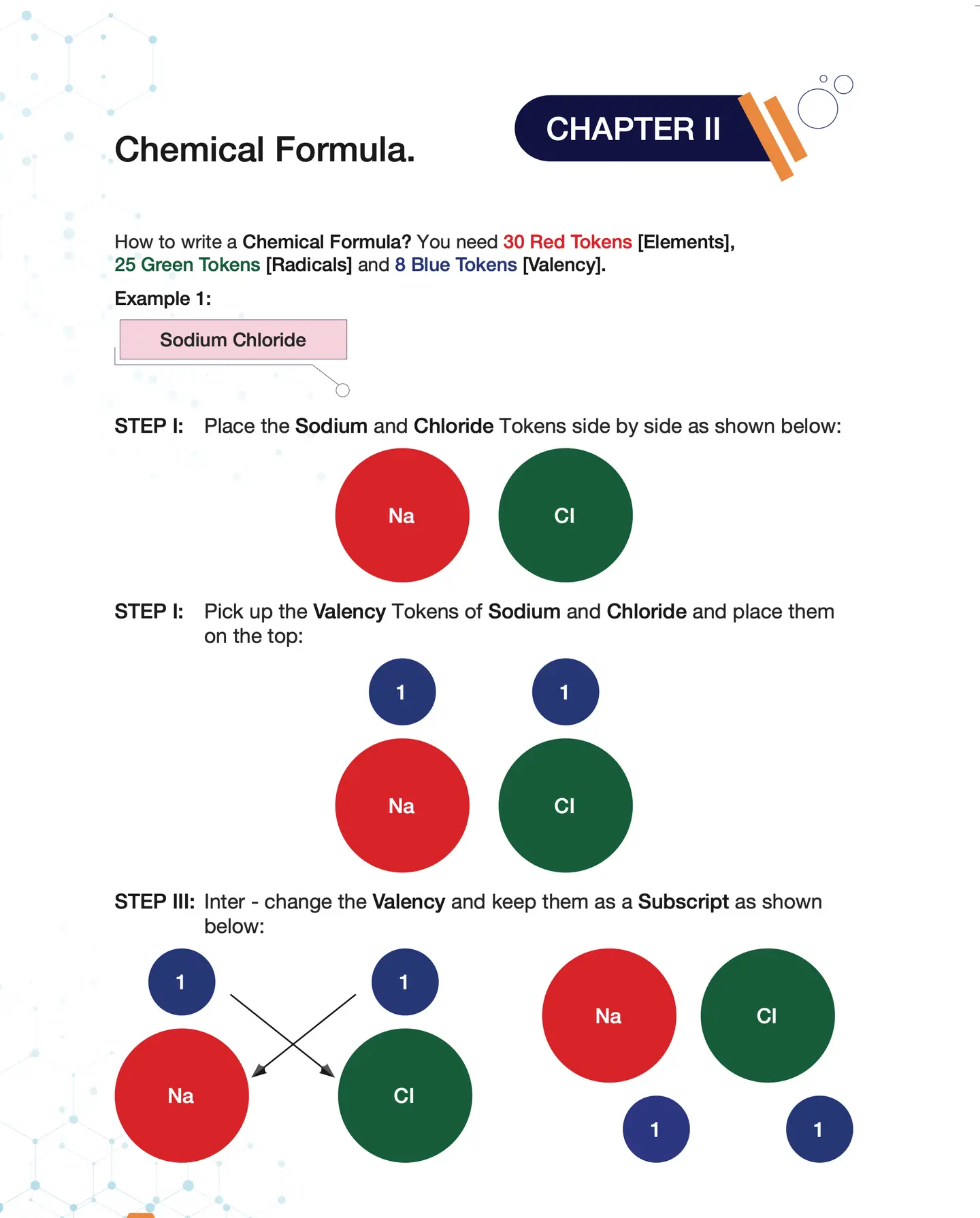
Sodium Chloride
Sodium Na · valency 1
Chloride Cl · valency 1
NaCl
Calcium Hydroxide
Calcium Ca · valency 2
Hydroxide OH · valency 1
Ca(OH)2
Aluminium Sulphate
Aluminium Al · valency 3
Sulphate SO4 · valency 2
Al2(SO4)3
Aluminium sulphate is the one that shows the bracket doing its work: the sulphate radical is a group, three of them are needed, and the subscript sits outside the bracket so it multiplies the whole group rather than the oxygen alone.
The 8 the rule does not build.
Knowing which formulas the rule does not reach is part of knowing the rule, and an aggregated formula list never tells you. These are found by running the rule rather than from a list kept beside it: each one below is a formula a board sets that no pair of parts produces.
CO, NO2, SO2 and SO3 are covalent oxides in which the non-metal combines at a valency the chart does not carry — carbon at 2, nitrogen at 4, and sulphur at 4 and at 6.
Fe3O4 carries iron in two states at once, ferrous and ferric together.
CH3COOH and CH3OH are written as organic formulas, by the carbon chain rather than by two parts.
CaOCl2 is bleaching powder, a mixed salt rather than one positive part and one negative one.
None of them is an error. They are the places where a formula records something the two-valency rule does not model — a covalent bond, a mixed oxidation state, a carbon chain — and a student who has been told the rule is universal meets them as a contradiction rather than as a boundary.
Which board sets what.
The Set by column above is the short answer. The long one is on each board's own page, chapter by chapter, with the equations as well as the formulas:
- ICSE — Classes 6 to 9. ICSE introduces chemistry in Class 6 and the language of chemistry with it — the names and symbols of the first twenty elements. Word equations follow in Class 7 and formulas in Class 8, but valency, the formulas of radicals and the balancing of equations are not taught until Class 9.
- CBSE — Classes 7 to 10. A CBSE student meets 79 chemical formulas and 70 chemical equations between Class 7 and Class 10, chapter by chapter. Writing a chemical formula is not explained until Class 9, and writing and balancing a chemical equation not until Class 10 — by which point both have been set in exercises for two years.
- SSLC — Classes 8 to 10. A Kerala SSLC student meets 52 chemical formulas and 51 chemical equations between Class 8 and Class 10, chapter by chapter. Balancing is explained first, in Class 8, before a chemical formula or a chemical equation has been explained at all; writing a formula follows in Class 9.
Questions
- How do you write a chemical formula?
- Write the positive part first and the negative part second, give each one the other’s valency as its subscript, and reduce to the lowest terms. Calcium is divalent and hydroxide is monovalent, so calcium hydroxide is Ca(OH)2. Magnesium and oxide are both divalent, so magnesium oxide is MgO and never Mg2O2.
- What is the criss-cross rule?
- The name for that swap: each part takes the other’s valency as its subscript. It is a rule about arithmetic, not about chemistry, and it only works once both valencies are known — which is why the valency chart comes first.
- When does a formula need brackets?
- When a compound radical — one that is a group of elements rather than a single one — appears more than once. Hydroxide is OH, so two of them is Ca(OH)2 and never CaOH2, which would say something different about the oxygen.
- Why does the same metal give two different formulas?
- Because some metals combine in more than one ratio, and the name has to say which. Iron is divalent as ferrous and trivalent as ferric, so “Iron Oxide” is not an answerable question: FeO is Iron(II) Oxide and Fe2O3 is Iron(III) Oxide.
- Do all chemical formulas follow the criss-cross rule?
- No. Of the 94 formulas the ICSE, CBSE and Kerala SSLC syllabuses set, 86 are built by it and 8 are not — the covalent oxides, one iron oxide carrying two states at once, two organic formulas and one mixed salt. All eight are named on this page with the reason.
This page is Step II. One comes before it, one after.
A table is something to look up. Chapter II of The Language of Chemistry, Playbook® is where a student stops needing to: the parts come as punch-out tokens, the formula is built with the hands before the pen, and the chapter does not open onto equations until the score is made.