
Classes 7 to 10 · ICSE / CBSE / SSLC
The Language of Chemistry, Playbook®
Thirty elements and twenty-five radicals as punch-out tokens, then chemical formulas, then balanced equations — with a score to reach before the next chapter.
First published in 1996 as Metro Kits, Kit–I.
Chemistry has a written language, and nobody teaches it as one. That is the whole of it. A student who cannot write a symbol cannot write a formula, and a student who cannot write a formula cannot balance an equation — and every board sets all three long before its own textbook explains how any of them work.
So the book teaches the language in the order a language is learned. Alphabets first: the full name, symbol, formula and valency of thirty elements and twenty-five radicals, printed as punch-out tokens on two sheets inside the book. Then words, which are chemical formulas. Then sentences, which are balanced equations.
What makes it a method rather than a question bank is that it will not let a student past. Each chapter runs Chart, then Activity, then Exercise, then a score against a chart — and below the threshold the whole set of exercises is repeated before the next chapter opens. The three thresholds are printed further down this page, and they are not soft.
Every exercise has its answers enclosed, and there is an evaluation chart at the back. A parent who never studied chemistry can still mark it.
What is in the box
A Playbook is not a book. It contains a game.
2 punch-out token sheets
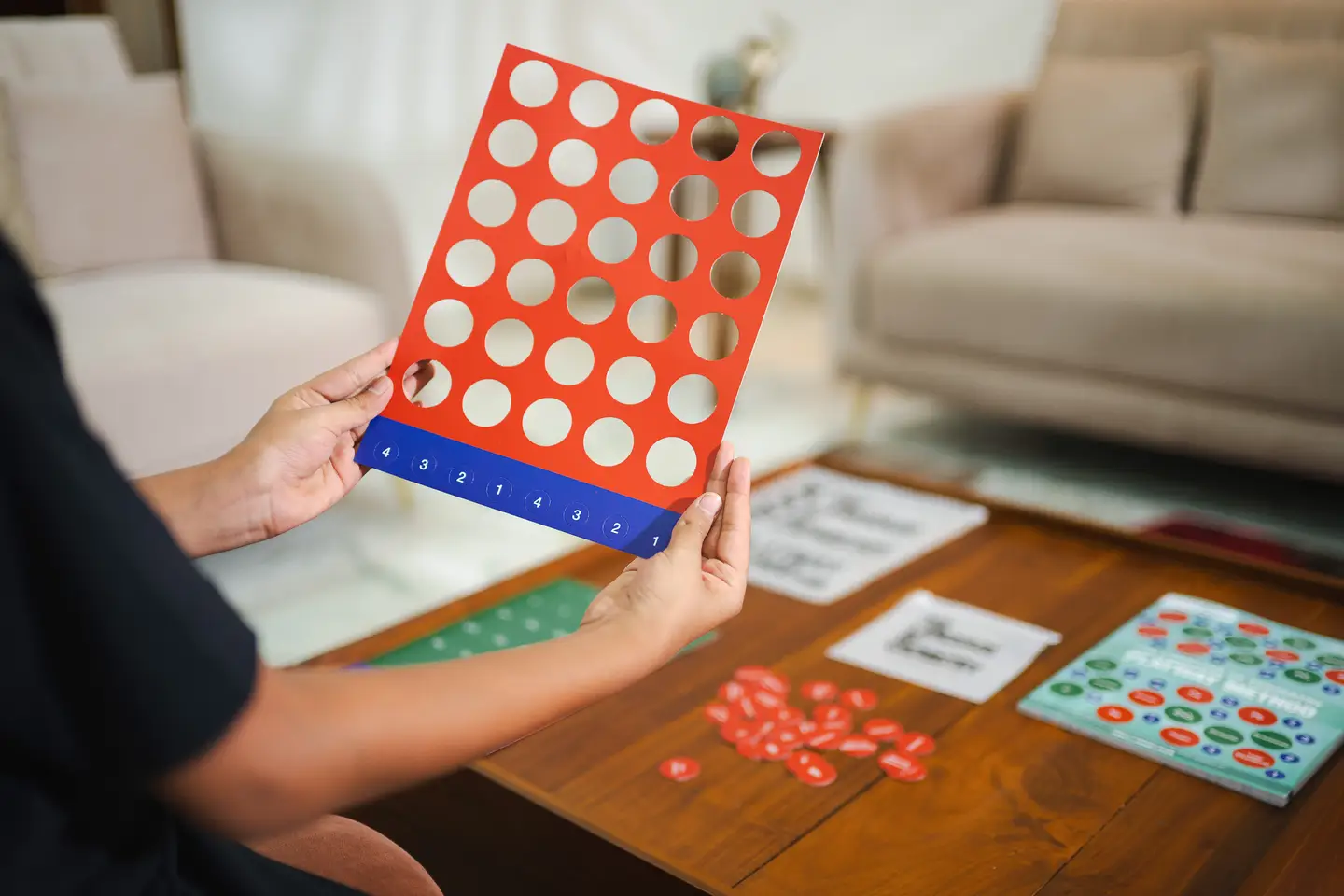
Thirty elements, twenty-five radicals and the valencies that join them, printed and die-cut so a student pushes them out and puts them on a table. The word on each token is the code, and the colour repeats it — an element, a radical, a valency. A radical carries an inner ring as well, so the three types stay apart on a photocopy and for a reader who cannot separate the red from the green.
- Na
- 1
- Cl
The three types are told apart by what they carry and how they are drawn, not by colour — a radical carries a ring, a valency is smaller and set in figures.
112 pages
The method, the charts, the activities and the exercises — in the order a student works through them.
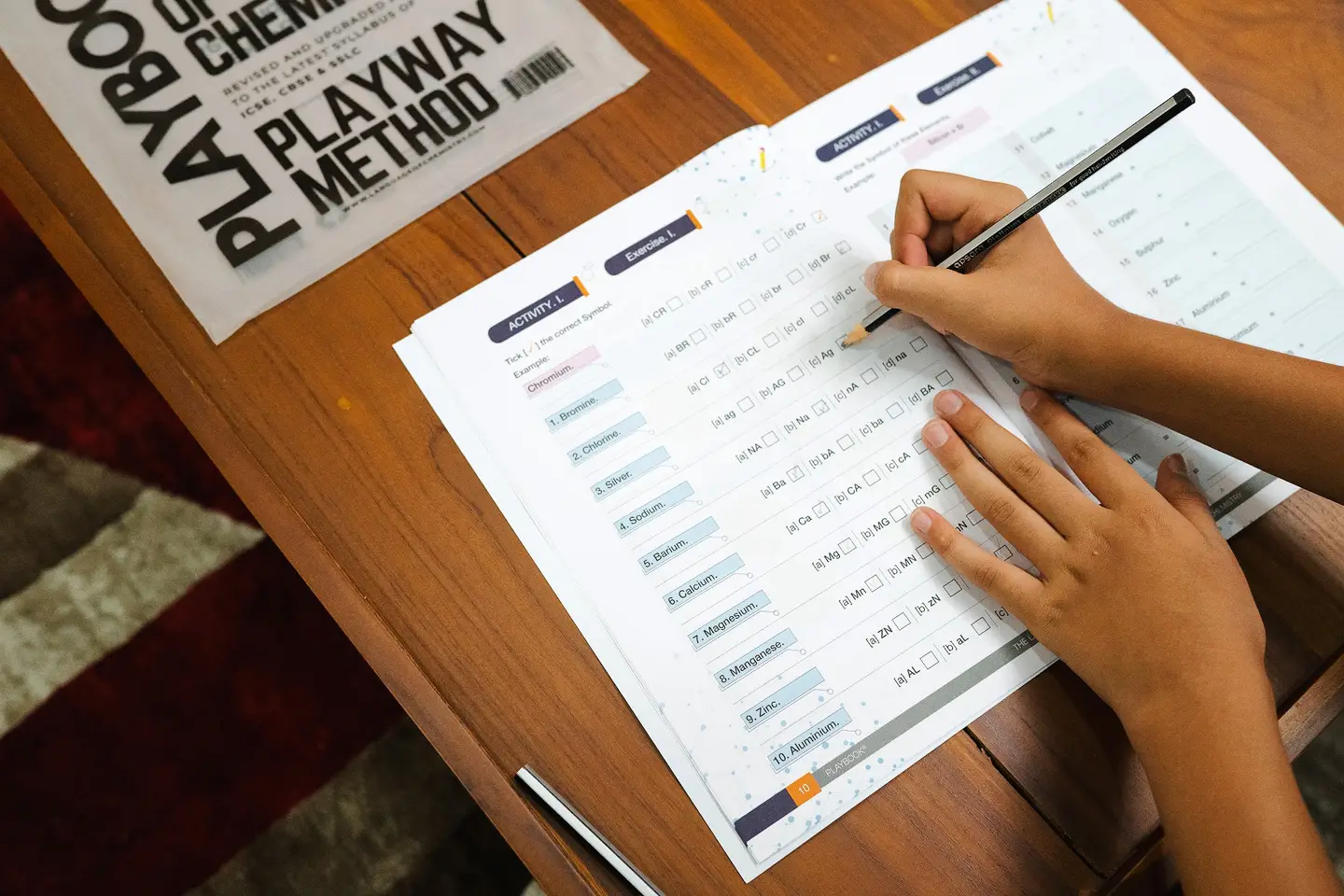
19 exercises, 279 questions
Across 6 activities and 2 charts. Enough repetition for the notation to become automatic, which is the entire point of drilling a language.
All answers enclosed
The book marks itself. A parent who never studied chemistry can still check the work, and nothing is held back for a separate guide.
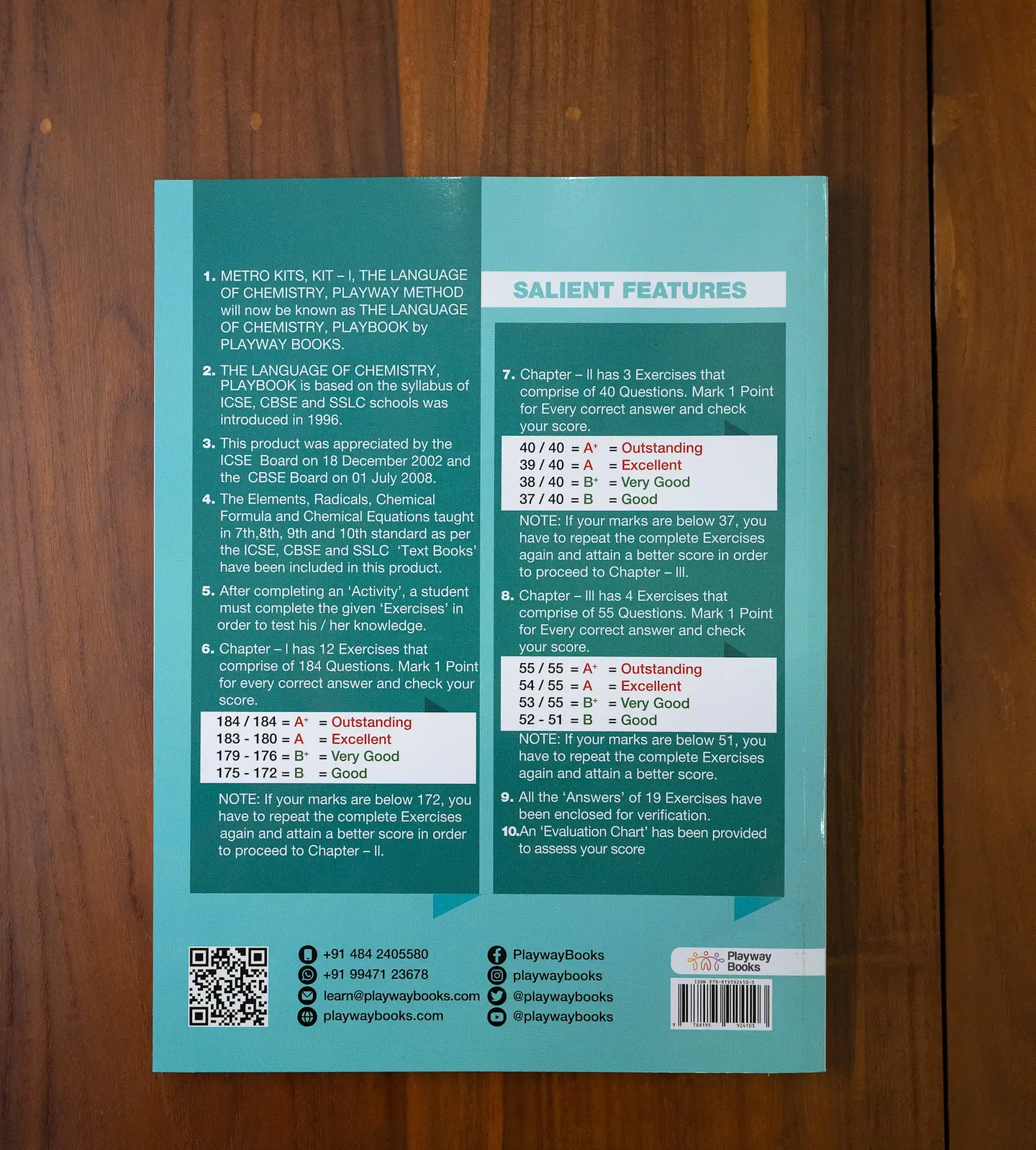
Evaluation chart
Scores are read against a chart, because the chapter gate is a number and not an opinion.
Look inside
Four pages. Then you will know.
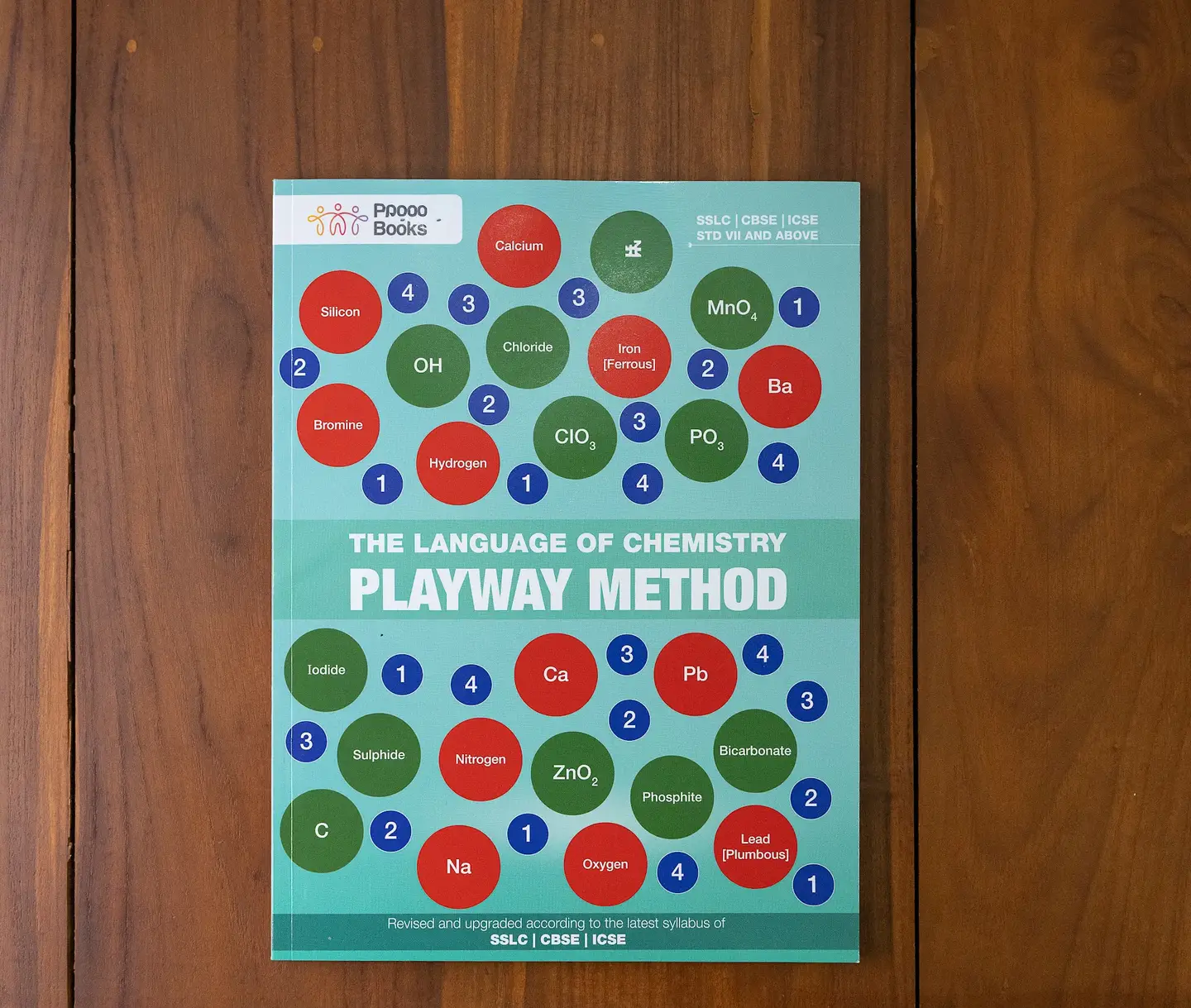
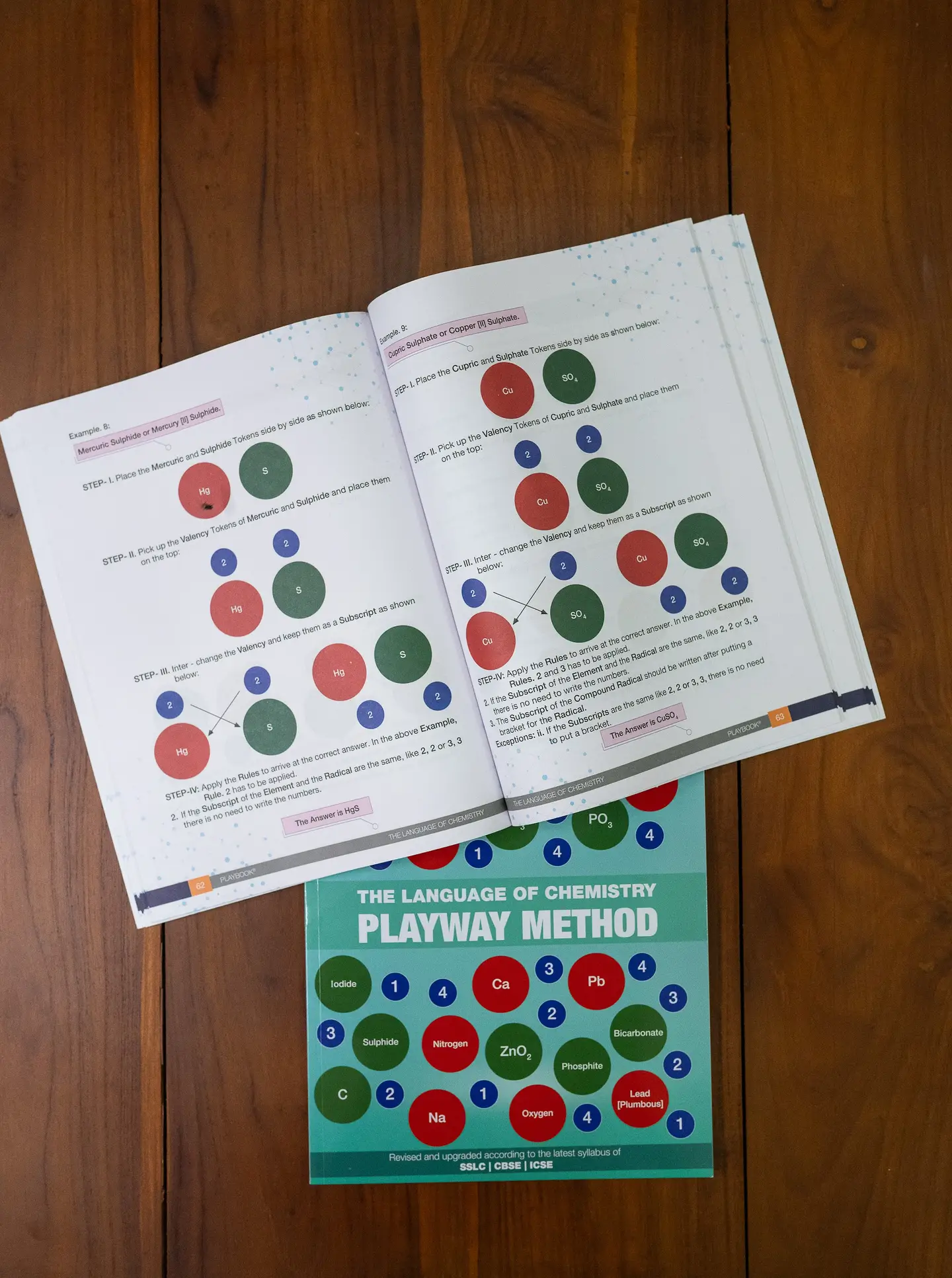
Nobody buys a method they have not seen. Two of the four pages that decide it: what arrives in the post, and the elements with their valencies.
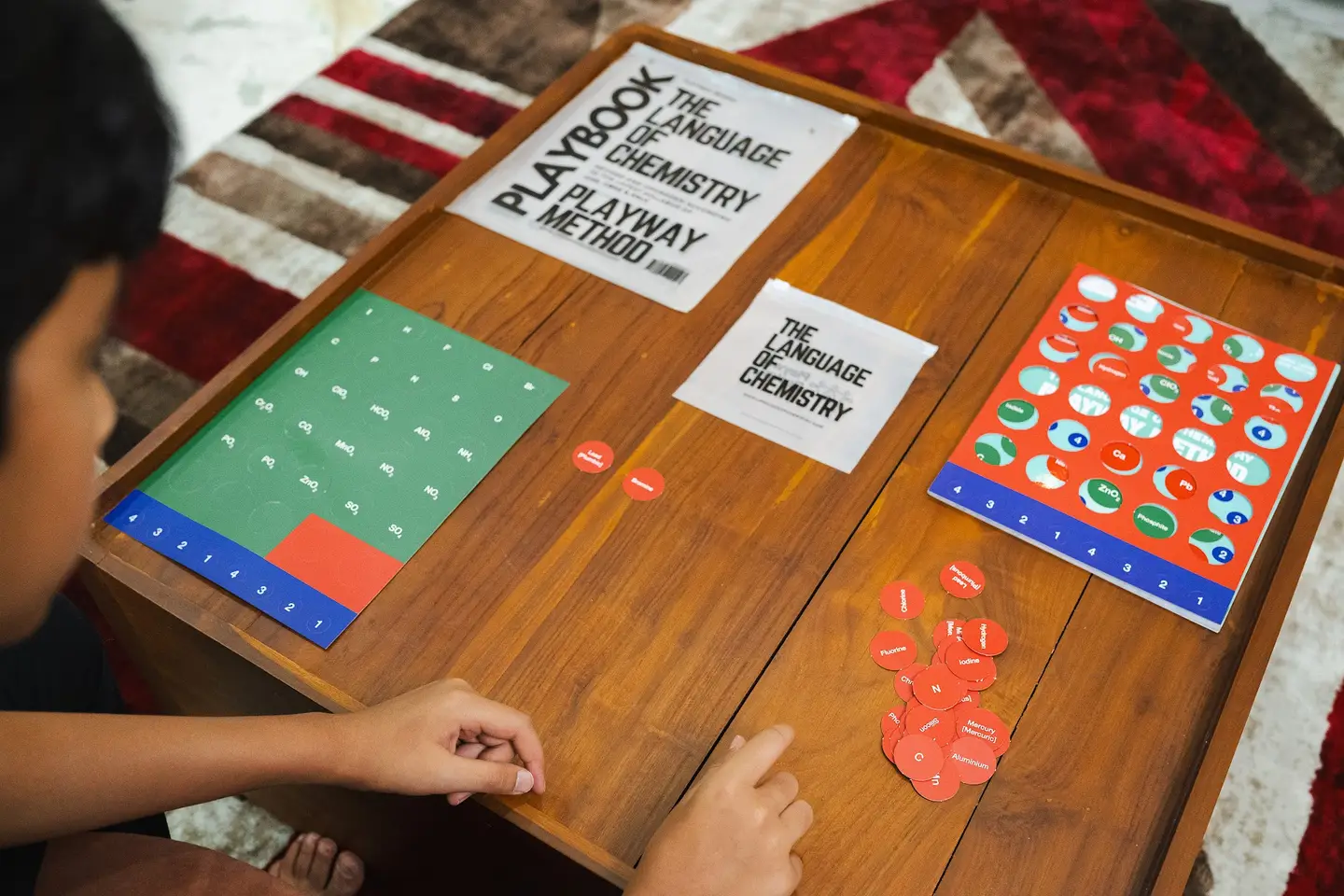
The book, and the two sheets
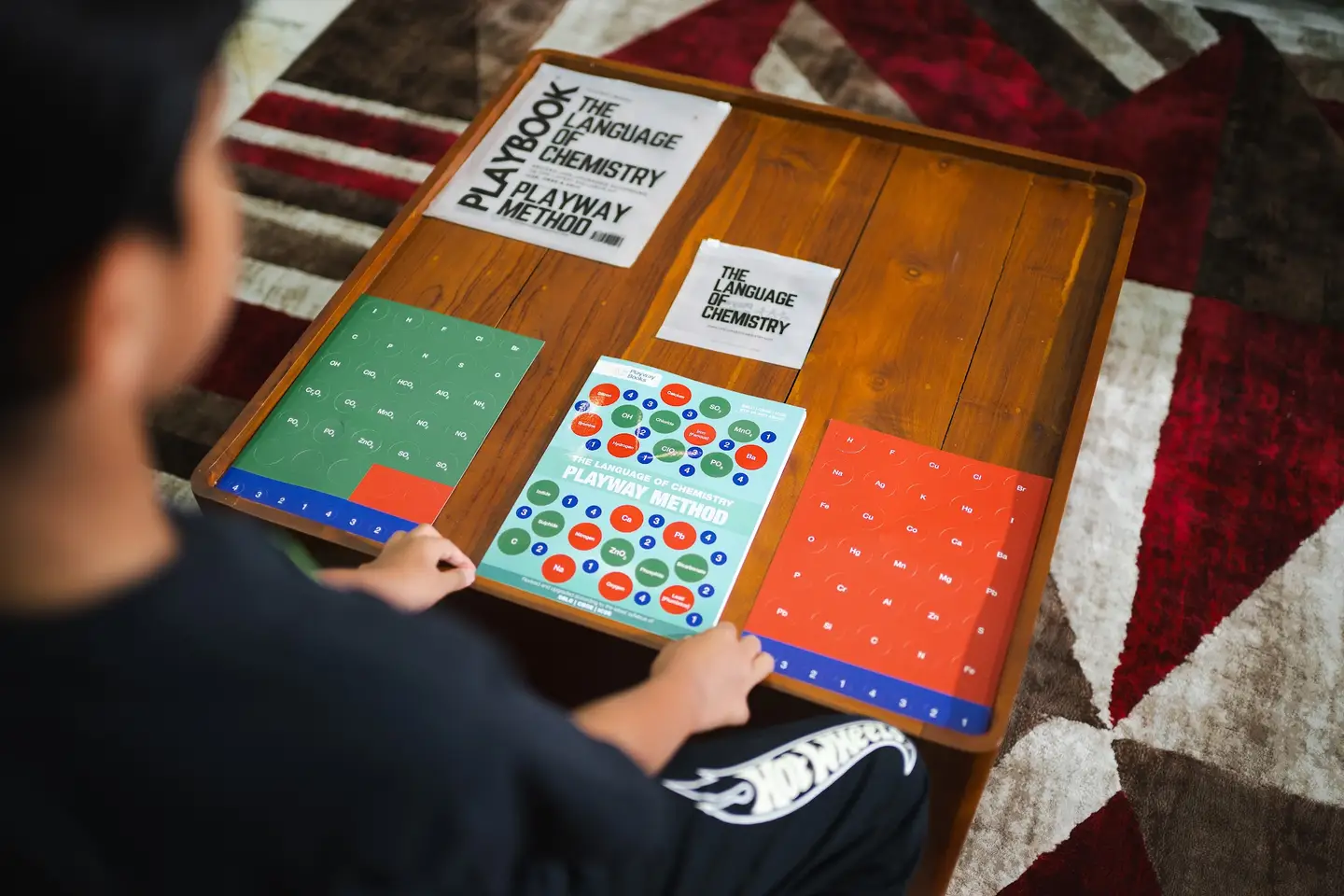
The book and its two punch-out sheets, laid out together — what a parent unboxes before a single formula appears.
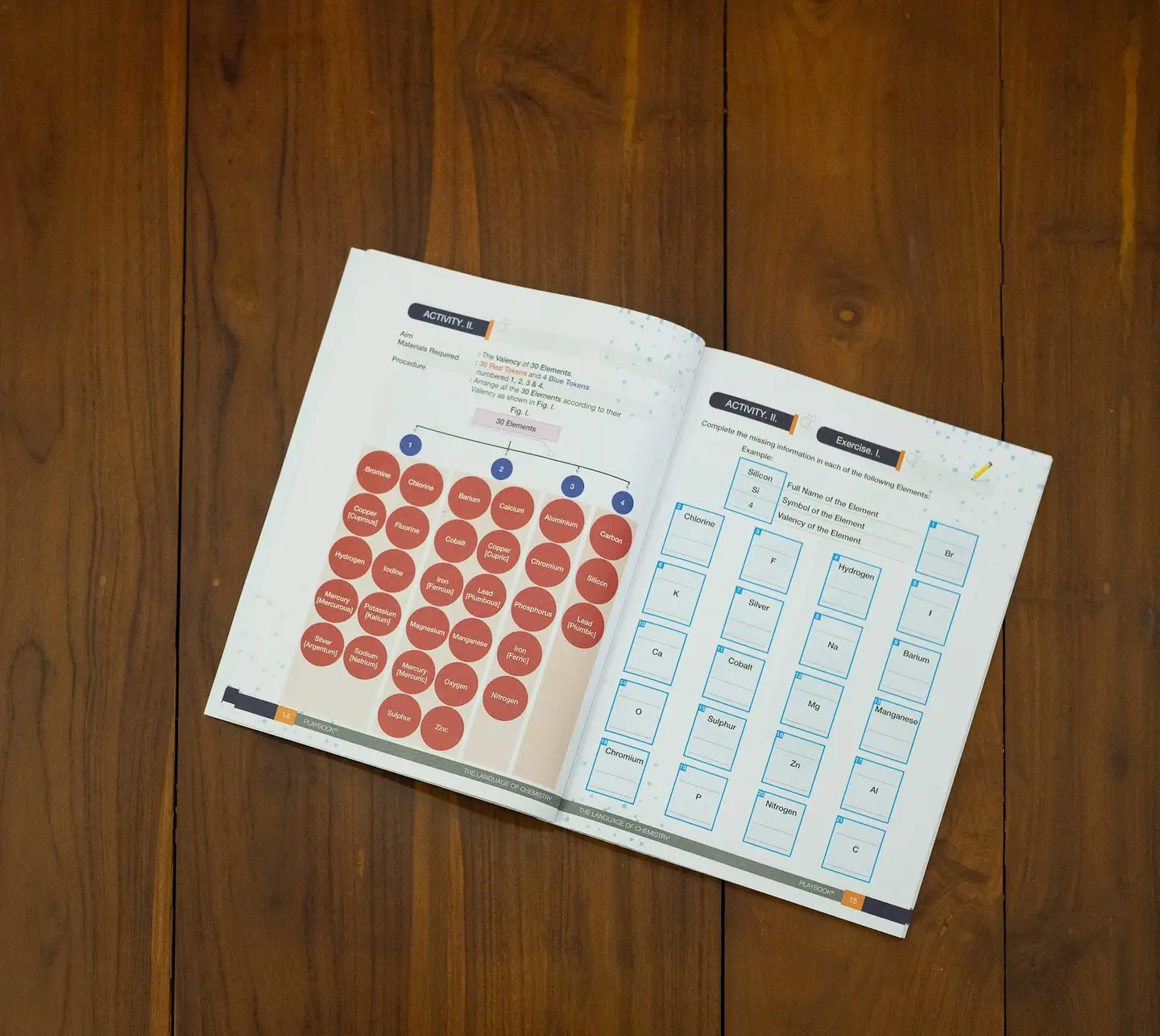
The elements, by valency
All thirty elements, each set as its full name and arranged by valency — the same information Chart I carries, read a different way. It is Activity II, on page 14.
Specification
| ISBN | 978-81-959241-0-3 |
|---|---|
| Pages | 112 |
| Charts | 2 — 30 elements, 25 radicals |
| Activities | 6 |
| Exercises | 19 |
| Questions | 279 |
| Enclosed | 2 punch-out token sheets · All answers to all 19 exercises · Evaluation chart |
| Class level | Classes 7 to 10 |
| Boards | ICSE · CBSE · SSLC |
| Edition | Playway Books Pvt Ltd edition |
| Dimensions | To be confirmed |
| Weight | 100 g |
| Published price | ₹399 |
The published price is Playway Books’ own. Retailers set their own prices and change them, so each buy button opens that retailer’s page rather than quoting a figure here. A row reading “to be confirmed” is a fact Playway Books has not yet verified — it is shown as unverified rather than estimated. Ask us and we will confirm it.
The gate
The book sends a student back. On purpose.
Each chapter runs the same way — a chart, then an activity, then the exercises, then a score read against a chart at the back. Below the threshold the whole set of exercises is repeated before the next chapter opens. Chapter I closes at 93.5%, which is a standard, not a pass mark.
Chapter I · Alphabets
172 / 184
93.5% to proceed
Chapter II · Words
37 / 40
92.5% to proceed
Chapter III · Sentences
51 / 55
92.7% to proceed
| Chapter | Exercises | Questions | To proceed | Below that |
|---|---|---|---|---|
| Chapter I — Alphabets | 12 | 184 | 172 of 184 · 93.5% | Repeat the exercises |
| Chapter II — Words | 3 | 40 | 37 of 40 · 92.5% | Repeat the exercises |
| Chapter III — Sentences | 4 | 55 | 51 of 55 · 92.7% | Repeat the exercises |
Chapter I — Alphabets
- 184 / 184
- A+ · Outstanding
- 183–180
- A · Excellent
- 179–176
- B+ · Very Good
- 175–172
- B · Good
Chapter II — Words
- 40 / 40
- A+ · Outstanding
- 39 / 40
- A · Excellent
- 38 / 40
- B+ · Very Good
- 37 / 40
- B · Good
Chapter III — Sentences
- 55 / 55
- A+ · Outstanding
- 54 / 55
- A · Excellent
- 53 / 55
- B+ · Very Good
- 52–51
- B · Good
All 19 exercises have their answers enclosed, and an evaluation chart at the back turns a score into a grade. The book marks itself — a parent who never studied chemistry can still use it, which is the part nobody currently knows.
Token Play
Join a token to a token. Watch the formula appear.
One round, the way a student plays it on a table with the punch-out sheet from The Language of Chemistry.
Choose a token, then choose the slot it belongs in. One element, one radical, and the valency that joins them — only one of the three numbered tokens is right. The valency is how many the element combines as; it is not part of the finished formula. On a keyboard: tab to a token, press Enter to pick it up, then tab or arrow to a slot and press Enter to drop it. Escape puts it back.
On the bench
The join
Choose a token to begin.
NaCl
The valencies crossed over. Sodium combines as one and chloride combines as one, so one of each is all it takes — and a subscript of 1 is never written. This is the book's first worked example, on page 28.
That is one word in the language of chemistry. The book has 19 exercises and 279 questions like it, and the tokens come punched out on 2 sheets inside it.
Weighing it against a guide book.
Playbook, textbook or guide book puts the three side by side row by row, including the two rows this one loses. The method itself is published free — the valencies, the formulas, the equations and practice sets — so it can be judged before it is bought.
Where to buy
Buy it where you already shop.
Available at Amazon.in · Flipkart · JioMart
There is no cart on this site. The book ships from the retailers below, and it is on the shelf in Kerala.
- Buy on Amazon.in
Amazon.in · Recommended
Usually delivered in 2–4 days
Price on the store page
- Buy on Flipkart
Flipkart
In stock
Price on the store page
- Buy on JioMart
JioMart
See JioMart for stock and delivery
Price on the store page
Prices are set by the retailer and change. Each button opens that retailer’s own page, where the current price is shown.