
The Playway Method · Classes 7 to 10
Chemistry has a written language. Alphabets, words, sentences.
Every board asks students to write symbols, formulas and equations. None of them stops to teach these. This book does, in three steps.
Chemistry is a branch of science — the study of what materials are made of, how they are built, what they do and how they react. Like any science it has a written language, and in chemistry that language is symbols, formulas and equations. Every board sets all three. None of them sets aside time to teach them.
This is the book that does. Alphabets, then words, then sentences — thirty elements and twenty-five radicals, then formulas, then balanced equations. Every step below carries a worked example, because a teacher decides on the example and not on the claim.
The Playway Method is Playway Books' own pedagogy, not a presentation style laid over someone else's syllabus. It is delivered through gamification — learning by play, with tokens a student moves by hand before writing anything down. There are no points, no streaks, no badges and no leaderboards in it. The reward for getting a formula right is the formula being right. Where it came from is a classroom in 1992.
“Chemistry involves the study of a large number of Elements and Compounds. It is very inconvenient to write the Full Names of Elements and Compounds. The creation of Symbols and Formula solved this problem. […] The 10th standard CBSE, ICSE and SSLC Examinations reveals the fact that the students find it very difficult to write Symbols, Chemical Formula and Balanced Chemical Equations.”
Four words, defined once
Four terms, and the book defines all of them.
All four are on page six, before a single exercise. A student who has these does not need to be told what a formula is again.
- Element
-
A substance which is constituted of only one kind of matter.
Aluminium, Copper.
- Symbol
-
A short, scientific mode of representing atoms of elements.
Barium = Ba. Calcium = Ca.
- Formula
-
A short, scientific mode of representing molecules of elements and compounds.
Hydrogen = H2 and oxygen = O2 are elements; water = H2O and sodium chloride = NaCl are compounds.
- Valency
-
The combining capacity of an element, measured by the number of atoms of hydrogen with which one atom of an element can combine.
Sodium combines with one atom of hydrogen, so its valency is 1. Calcium combines with two, so its valency is 2.
Why a valency token stops at four
A valency token carries a bare digit, and the book names each one. There is no valency token for 5 and none for 0, because the book sets four names and no more.
- 1
- Monovalent
- 2
- Divalent
- 3
- Trivalent
- 4
- Tetravalent
The four valency tokens
- 1
- 2
- 3
- 4
Step I
Alphabets
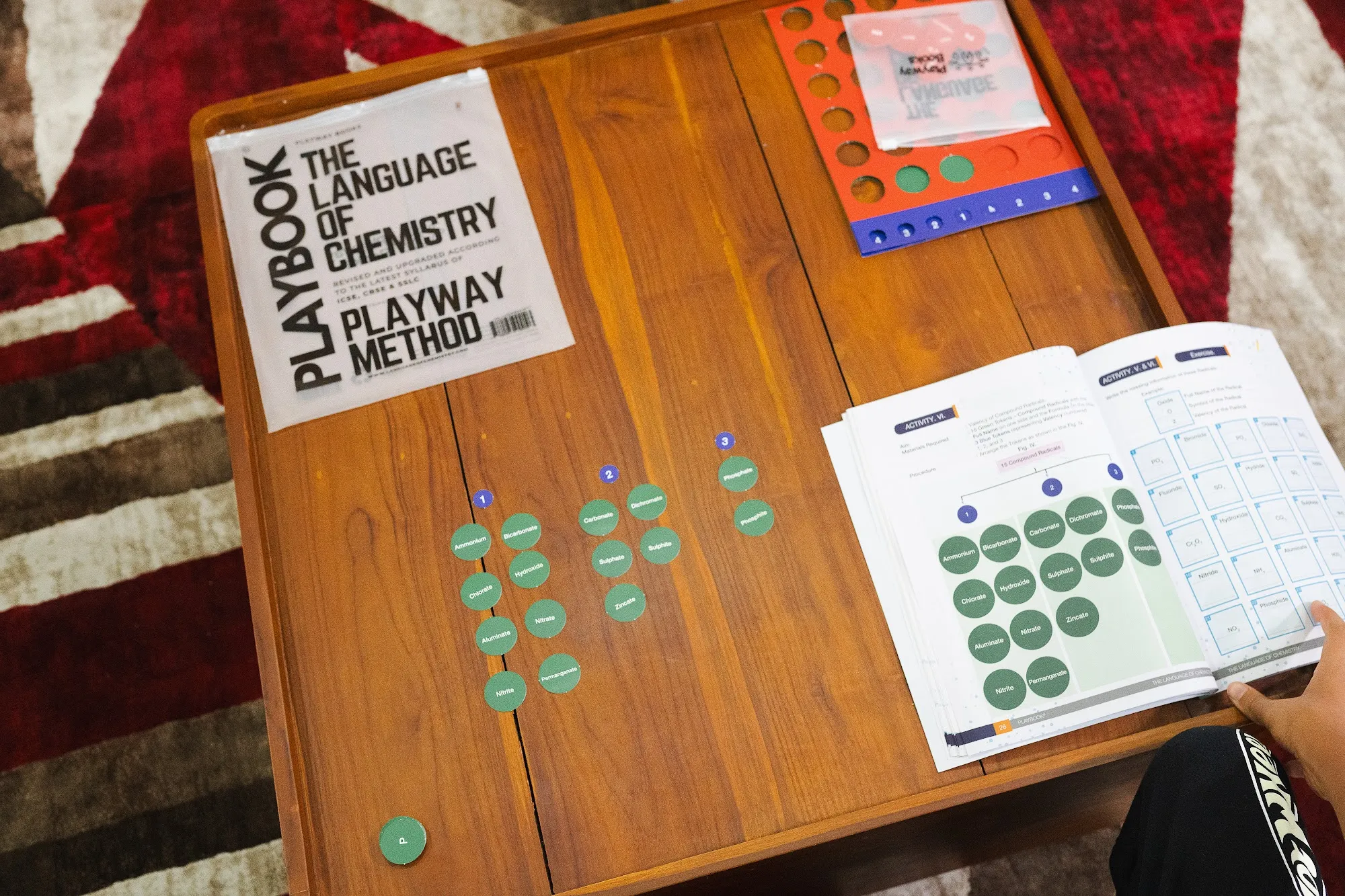
The full name, symbol, formula and valency of thirty elements and twenty-five radicals — learned as objects rather than as a list to be memorised.
Worked example
- Na
- 1
- Cl
The student punches the tokens out and sorts them. Every element token is printed on both sides — the full name on one face and the symbol on the other, Sodium and Na on the same piece of card. Turning it over and knowing those are the same thing is the first skill the book drills. 6 activities and 12 exercises sit between the charts and the gate.
Chart I lists thirty elements and Chart II twenty-five radicals, each with its name, symbol or formula, and valency. The tokens come punched out of two separate sheets enclosed with the book — one for every row of those two charts, plus the valency tokens — so a chart stays open on the page while the tokens are in hand.
Step II
Words
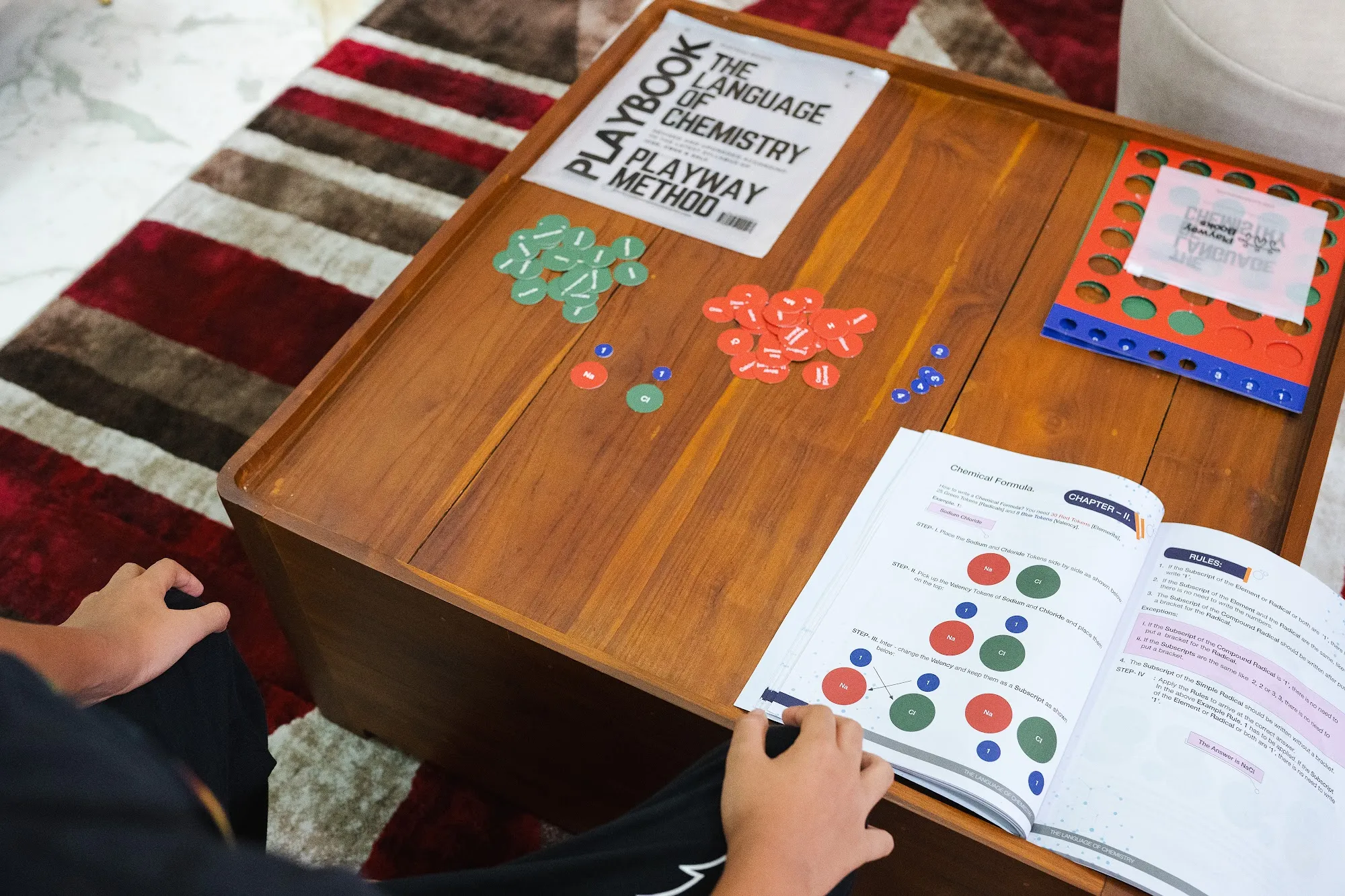
A formula is a word. It is built by joining a token to a token with a valency, not by remembering it.
Worked example
NaCl Zn(OH)2 Na2CO3
Sodium is monovalent and chloride is monovalent, so they join one to one. The formula is NaCl — sodium chloride, and it is the example the book works first. Zinc joins two hydroxides, because zinc is two and hydroxide is one. The formula is Zn(OH)2, and the brackets are not a convention to be learned: they are what the join looks like when it happens twice.
25 worked examples, then 10 more for elements with a variable valency — copper and iron, the two that catch students out in every board.
Step III
Sentences
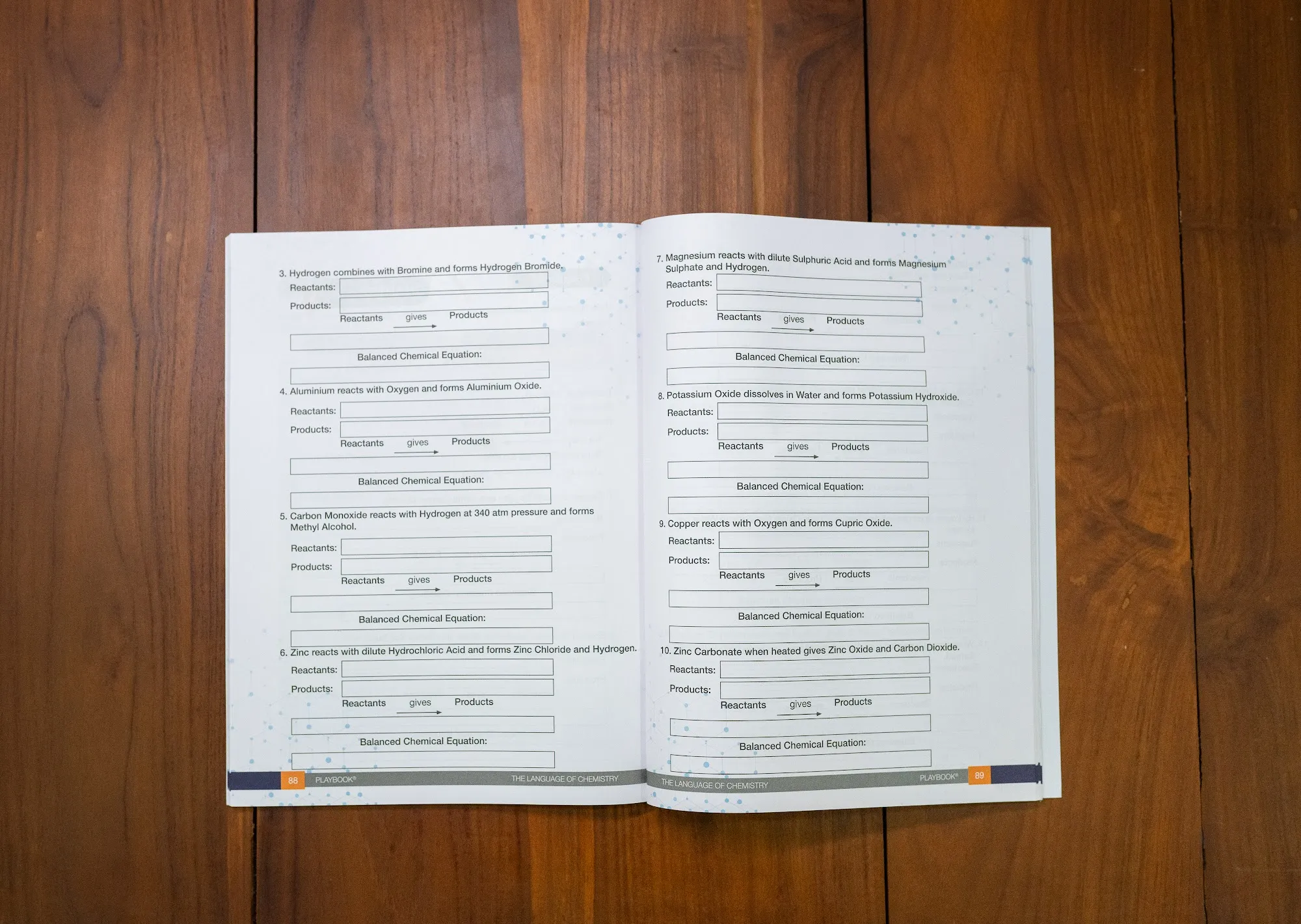
An equation is a sentence, and the equation written for a reaction has to balance on both sides.
Worked example
CaCO3 → CaO plus CO2
Calcium carbonate heated gives calcium oxide and carbon dioxide. The student writes the sentence, then counts each element on each side until the two sides agree. It has to agree because a chemical change only rearranges atoms — none is made and none destroyed — so every atom that goes in has to come out somewhere.
25 worked equations, then 4 exercises. The senior title carries reversible reactions, where the sentence runs both ways at once.
Equations, balanced. With the Playbook®.
Step III is the only one of the three a board examines directly. The first two are what make it writable, which is why the score below is taken at the end of each step rather than at the end of the book — a student who reaches the equations still guessing at a valency has three chapters of arithmetic and no alphabet.
The gate
The book sends a student back. On purpose.
Each chapter runs the same way — a chart, then an activity, then the exercises, then a score read against a chart at the back. Below the threshold the whole set of exercises is repeated before the next chapter opens. Chapter I closes at 93.5%, which is a standard, not a pass mark.
Chapter I · Alphabets
172 / 184
93.5% to proceed
Chapter II · Words
37 / 40
92.5% to proceed
Chapter III · Sentences
51 / 55
92.7% to proceed
| Chapter | Exercises | Questions | To proceed | Below that |
|---|---|---|---|---|
| Chapter I — Alphabets | 12 | 184 | 172 of 184 · 93.5% | Repeat the exercises |
| Chapter II — Words | 3 | 40 | 37 of 40 · 92.5% | Repeat the exercises |
| Chapter III — Sentences | 4 | 55 | 51 of 55 · 92.7% | Repeat the exercises |
Chapter I — Alphabets
- 184 / 184
- A+ · Outstanding
- 183–180
- A · Excellent
- 179–176
- B+ · Very Good
- 175–172
- B · Good
Chapter II — Words
- 40 / 40
- A+ · Outstanding
- 39 / 40
- A · Excellent
- 38 / 40
- B+ · Very Good
- 37 / 40
- B · Good
Chapter III — Sentences
- 55 / 55
- A+ · Outstanding
- 54 / 55
- A · Excellent
- 53 / 55
- B+ · Very Good
- 52–51
- B · Good
All 19 exercises have their answers enclosed, and an evaluation chart at the back turns a score into a grade. The book marks itself — a parent who never studied chemistry can still use it, which is the part nobody currently knows.
Against your syllabus
Every board asks for it before it teaches it.
The Playbook does not follow a board’s chapter order, and it is not a substitute for the textbook. It teaches the notation each board assumes a student already has — which, as each board’s own textbook shows, is assumed rather earlier than it is explained.
| ICSE Indian Certificate of Secondary Education | CBSE Central Board of Secondary Education | SSLC Secondary School Leaving Certificate, Kerala | |
|---|---|---|---|
| Chemistry starts | Class 6 | Class 7 | Class 8 |
| Classes covered | Classes 6 to 9 | Classes 7 to 10 | Classes 8 to 10 |
| Chemical formulas to write | Set by theme rather than enumerated | 79 listed | 52 listed |
| Chemical equations to write | Set by theme rather than enumerated | 70 listed | 51 listed |
| When writing them is taught | Symbol, valency, formula of radicals and balancing — Class 9 | Writing a formula — Class 9. Writing and balancing an equation — Class 10. | Writing a formula — Class 9. |
-
ICSE — the gap
The Council’s own annual Pupils Performance Analysis identifies writing symbols, chemical formulas and balanced equations as a persistent difficulty.
-
CBSE — the gap
Formulas appear from Class 7 and equations from Class 7, but writing a formula is not explained until Class 9 and balancing not until Class 10.
-
SSLC — the gap
Balancing equations is explained in Class 8, Part I, Chapter IV, before a chemical formula or a chemical equation has been explained at all.
Notes on the textbooks, from reading them
These are the author’s own notes, made while mapping the book against each board. They are observations about a textbook, not a complaint about a board — and they are the clearest evidence that the gap above is real.
| Board | Where | The note |
|---|---|---|
| CBSE | Class 7, Chapter VI — Physical and Chemical Changes | Two of the chemical equations given in the chapter are not balanced. |
| CBSE | Class 7, Chapter VI | Fe2O3 is named Iron Oxide. The correct name is Iron(III) Oxide, or Ferric Oxide — Iron Oxide is Fe3O4. |
| CBSE | Class 9, Chapter III — Atoms and Molecules | An exercise asks for the formula of “Copper Nitrate”. Writing it requires a valency, so Copper(II) Nitrate — or Cupric Nitrate — would be answerable and Copper Nitrate is not. |
| CBSE | Class 10, Chapter III — Metals and Non-metals | The names of Cu2O and Cu2S are not given. They are Copper(I) Oxide and Copper(I) Sulphide — cuprous oxide and cuprous sulphide. |
| SSLC | Class 8, Part I, Chapter IV — Basic Constituents of Matter | Balancing of chemical equations is explained without a chemical formula or a chemical equation having been explained first. |
| SSLC | Class 9 | The variable valency of copper and iron is not explained, so the names of CuSO4, Cu(NO3)2, FeSO4 and FeCl2 cannot be worked out from what has been taught. |
What it is, and what it is not.
The last two rows are the honest ones. The Playbook is not a substitute for the textbook and does not follow your board’s chapter order — it teaches the language every chapter is written in.
| A textbook | A guide book | The Playbook | |
|---|---|---|---|
| Teaches the notation itself | Assumes it | Assumes it | Teaches it |
| Drills to mastery | No | Some practice | 19 exercises, 279 questions |
| Gates progress on a score | No | No | Yes — 172 of 184, then 37 of 40, then 51 of 55 |
| Answers included | Usually not | Yes | Yes, all of them |
| Is played with objects | No | No | Yes — 2 punch-out token sheets |
| Follows your board’s chapter order | Yes | Yes | No — it is ordered by the language, not the syllabus |
| Covers the full syllabus | Yes | Yes | No — it covers the notation the syllabus assumes |
The three steps, published in full.
Each step has a reference page on this site, free and open. The argument for the book is the method rather than the material. Valency and radicals is Step I, the formula index is Step II, and balancing equations is Step III. The glossary defines the terms all three use, and the practice sets put them to work.
Playbook, textbook or guide book takes the table above row by row, including the two rows the Playbook loses. For parents is the same method described as what an adult actually does at home, and For students is it written to the student who has to do the work.
Look inside
Four pages. Then you will know.
Nobody buys a method they have not seen. Two of the four pages that decide it: what arrives in the post, and the elements with their valencies.
-
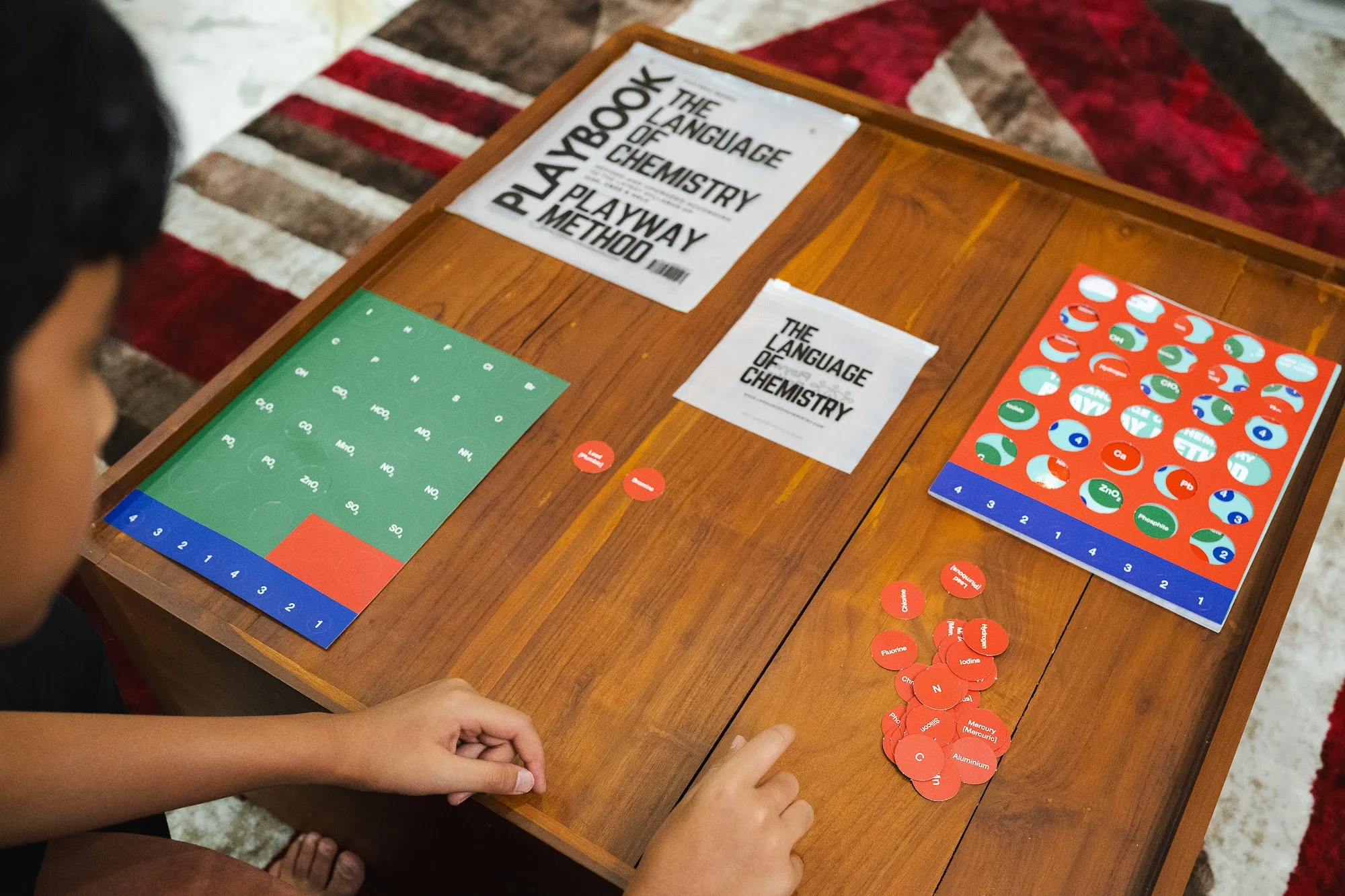
The book, and the two sheets
The book and its two punch-out sheets, laid out together — what a parent unboxes before a single formula appears.
-
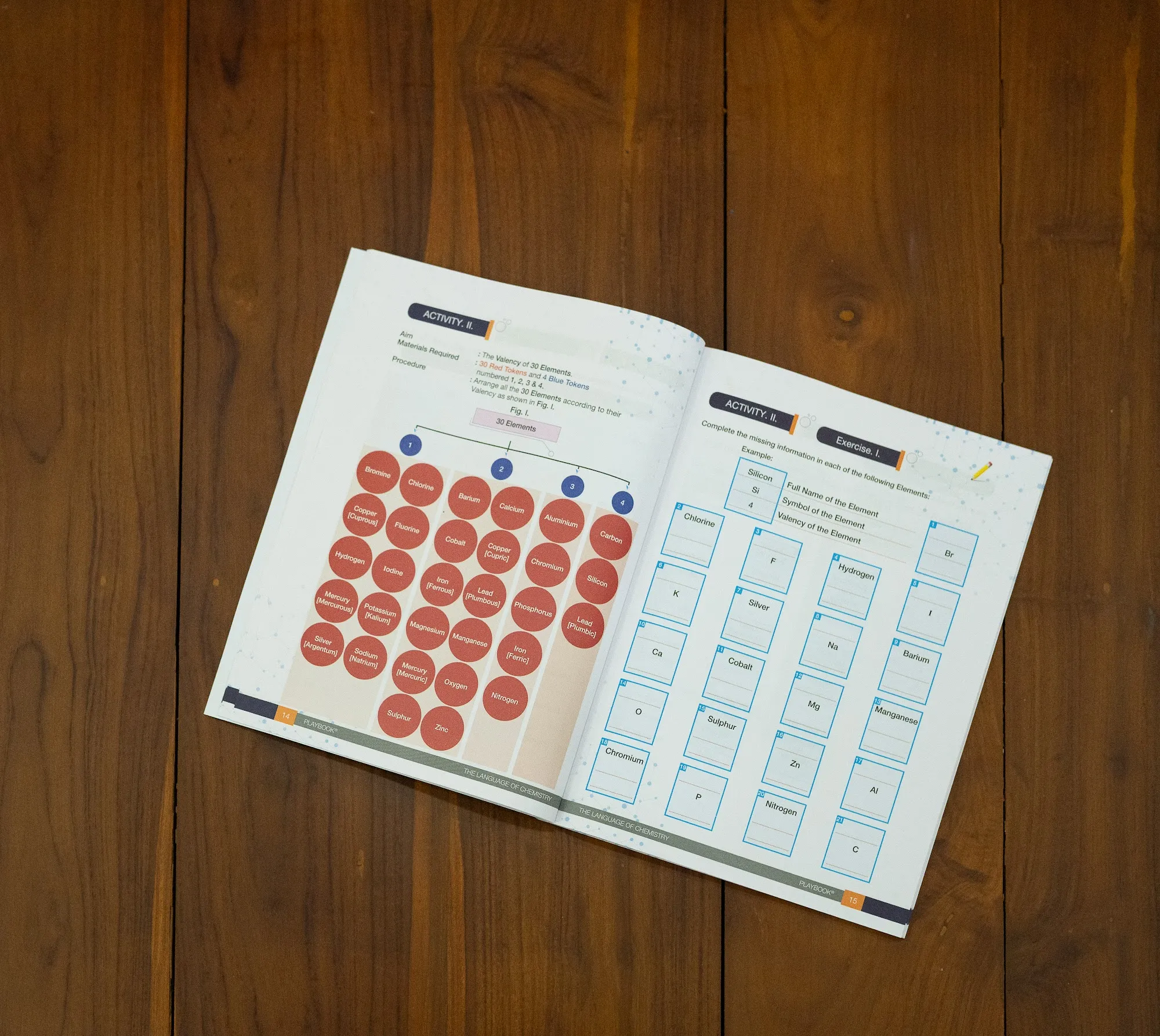
The elements, by valency
All thirty elements, each set as its full name and arranged by valency — the same information Chart I carries, read a different way. It is Activity II, on page 14.
Try it with one class before you decide.
Playway Books sends a sample copy to a school that asks, with bulk pricing and a board-by-board syllabus mapping.